
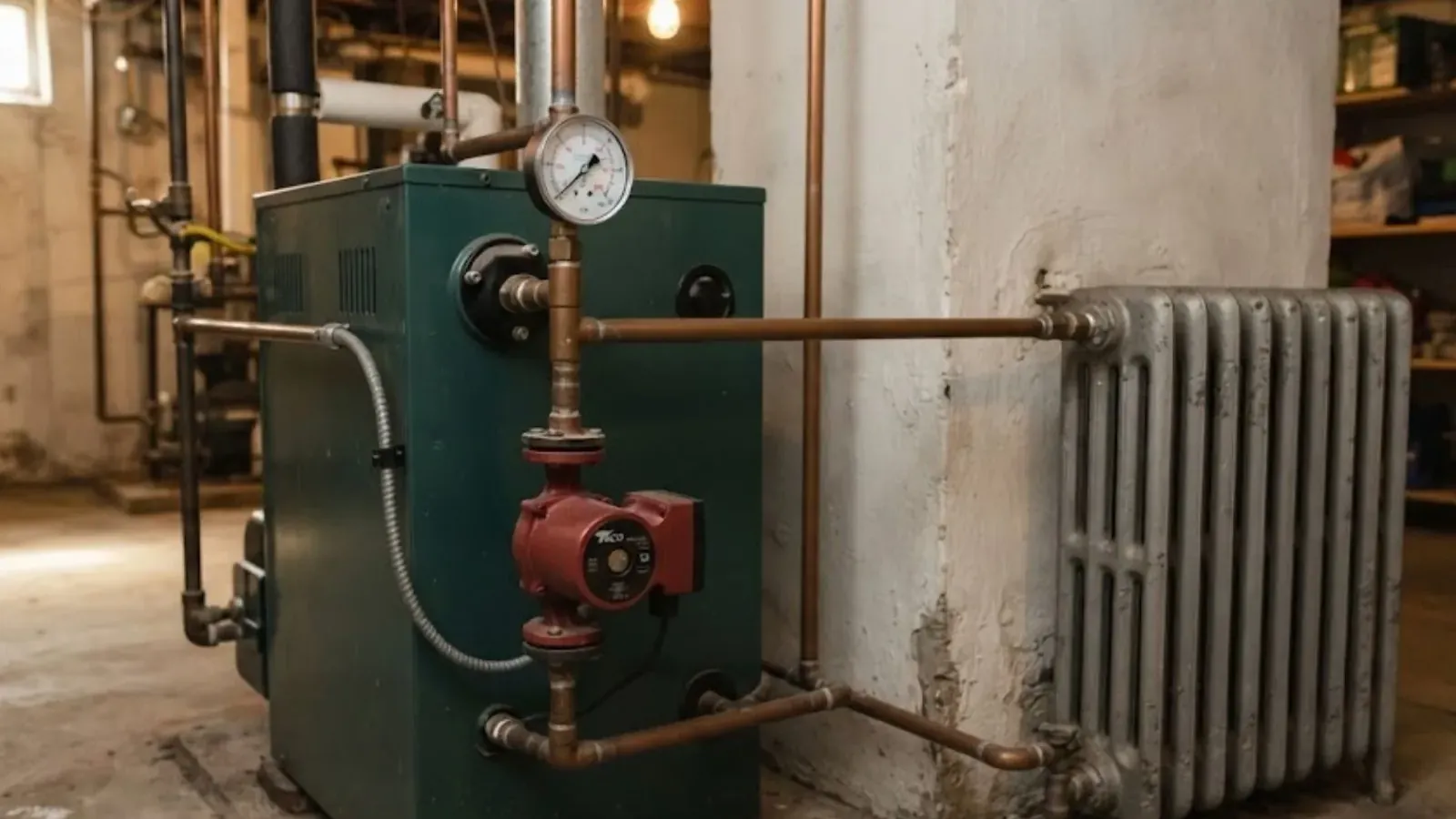
No heat in winter: what to do first
Check for gas first. Boilers burn fuel, and the first rule is to treat any gas smell as a life-safety issue, not a repair call. Then work through the simple checks while a plumber is on the way.
- If you smell gas, leave the building at once, do not flip switches or use a phone inside, and call your gas utility's emergency number or 911 from outside. Call us after the utility says it is safe.
- If a carbon monoxide alarm is sounding, get everyone outside into fresh air and call 911.
- Check the thermostat is set to heat and above room temperature, and that the boiler switch and the breaker for it are on.
- Look at the pressure gauge. A cold boiler usually reads in the range of 12 to 15 psi. Near zero, or very high, tells us what to look for.
- Call (973) 488-5410 and give us the make, the fuel, any error light or code, and whether you see water under the boiler.
Do not keep resetting a boiler that keeps locking out. Each reset on a failed ignition can pile up unburned fuel in the combustion chamber.
Why a boiler stops heating
The cause is usually one of a short list. The ignitor or flame sensor is dirty or worn, so the burner will not stay lit. The circulator pump has failed, so hot water never leaves the boiler. A zone valve is stuck. Pressure has dropped because of a leak, or the expansion tank has lost its air charge.
Sometimes the problem is the controls. A low-water cutoff that is dirty will shut the boiler down for safety, and a faulty thermostat or relay can leave a perfectly good boiler idle. Telling those apart takes testing, not guessing, which is why we ask what lights and sounds you see when you call.
What the symptom usually points to
No guide replaces a test, but these are the patterns we see most often and what they typically mean.
| Symptom | Likely cause | Next step |
|---|---|---|
| Boiler runs but radiators stay cold | Failed circulator, air in the system or a stuck zone valve | Check pump and zone valves, then bleed the air |
| Clicking, then no flame | Dirty flame sensor, bad ignitor or no gas flow | Clean or replace the part and test combustion |
| Banging or knocking in the pipes | Air, trapped condensate in steam, or flow problems | Bleed and rebalance, or fix the pipe pitch |
| Water pooling under the boiler | Leaking relief valve, fitting or a cracked section | Shut the water feed, call right away, do not refill repeatedly |
| Pressure keeps dropping | Small leak or a failed expansion tank | Pressure test and inspect the tank and valves |
A starting point, not a diagnosis. We test the boiler on site and give a clear price before repairs begin.
A pressure relief valve that drips is a safety device doing its job. Do not cap it or plug it, because the pressure it is relieving has a cause.
Steam, hot water and why they are different jobs
A hot water boiler pushes heated water through the pipes with a circulator pump, and the system is closed and pressurized. A steam boiler boils water into steam, which rises through the pipes by itself and condenses back at the radiators. They look alike in a basement, but they fail in different ways and need different skills.
Steam systems are more sensitive to water level, vent valves and pipe pitch. Hot water systems lean on pump flow, air removal and pressure. Older buildings in this area often have one or the other, and we ask which you have before we arrive.
No heat and the house is getting cold?
If there is no gas smell, call the 24/7 line. We will walk through the quick checks and give you a clear price before work starts.
Call (973) 488-5410Gas, carbon monoxide and when a boiler is unsafe
If you smell gas, the answer is the gas utility or 911, not a plumber. If your carbon monoxide alarm sounds, go outside and call 911. A cracked heat exchanger, a blocked flue or a failing burner can produce carbon monoxide, which has no smell.
A boiler that lights with a loud bang, burns with a yellow or lazy flame, leaves soot around the cabinet or shows scorch marks at the draft hood is unsafe to run. We shut it off, explain what we see and do not leave it running if we find a safety failure. In that case a repair may not be the right answer, and we say so.
Boiler work involves gas, venting and pressure vessels. According to the state Uniform Construction Code, a permit is required for plumbing work on existing buildings, and the only exemption is ordinary maintenance such as routine repair, so ask the construction code office about replacements.
Older boilers in an older town
Kearny's mills and housing date to the late 1800s and early 1900s, so older homes are common here, and many of them still run on old cast iron boilers and radiators. That is general knowledge about the era, not a claim about any one building. A well-kept cast iron boiler can run for decades.
The trade-off is parts and efficiency. Fifty-year-old gas valves and controls can be hard to find, and a boiler that needs a major repair each season may be cheaper to replace. We give you both numbers and say honestly when repair is the better call. In nearby Belleville we see many of the same systems.
What affects the price of boiler repair
We give a clear price before work starts. These are the factors that move it most.
If the repair would cost a large share of a new boiler, we tell you so. Want a real number? Call (973) 488-5410 and tell us the symptoms.
Before the cold sets in: a boiler check you can do
A few simple checks in the fall prevent a lot of January calls. None of these require opening the boiler.
- Run the heat for a few minutes now and confirm every radiator or zone warms up.
- Look for drips, rust stains or crusty deposits on pipes, valves and the boiler base.
- Check that the pressure gauge sits in its normal range when the boiler is cold.
- Keep the area around the boiler clear for air and access, with nothing stored against it.
- Test your carbon monoxide alarms and replace the batteries.
A yearly service visit cleans the burner, tests the controls and checks combustion. If hot water also runs out, see water heater repair, since the two sometimes share parts of the same system.
Permits and replacement
Boiler replacement involves gas, venting and water connections, and permit rules vary, so ask the construction code office about your job. Kearny requires an inspection for every permit it issues. The Construction Code Enforcement front office is open weekdays 8 am to 4 pm, and the number is (201) 955-7880.
A routine repair, such as replacing a pump or a sensor, is generally ordinary maintenance under New Jersey's construction code. A new boiler is a different matter. We explain what applies to your job before we start, and the work is done to code.
Frequently asked questions
It depends on the part that failed, the boiler type, its age and whether it is an after-hours call. A sensor or thermostat is a small repair, and a heat exchanger usually means replacement. We give a clear price before work starts, and you can call (973) 488-5410 to describe the symptoms.
Yes. The dispatch line is open 24 hours a day, seven days a week, and a no-heat call in winter is handled as an emergency at any hour. Same-day appointments are available for noisy or inefficient boilers when the schedule allows. If you smell gas, call the utility or 911 first.
Leave the building right away without using switches or phones inside. Call your gas utility's emergency number or 911 from outside. Do not try to find the leak or relight anything. Call us only after the utility confirms it is safe to go back in.
A drop in pressure means water is leaving the system or the expansion tank has lost its air cushion. Look for drips at valves, fittings and the relief valve. A pressure test finds small leaks, and refilling again and again without finding the cause hides the problem.
If the repair is small and the boiler is otherwise sound, repair it. If it needs a major part, has a cracked section, or fails each season, replacement is often the better value. We explain both options and let you decide.
In hot water systems it is usually trapped air or a flow problem. In steam systems it is often water trapped in a pipe that slopes the wrong way or a radiator valve that is not pitched correctly. Bleeding or adjusting it fixes most cases.
Routine repair is generally ordinary maintenance under New Jersey's construction code. A new boiler involves gas, venting and water connections. Permit rules vary, so ask the Kearny construction code office. Every permit requires an inspection.
Unsure whether it is safe to run? Call the 24/7 line and describe what you see, hear and smell.
Call (973) 488-5410