
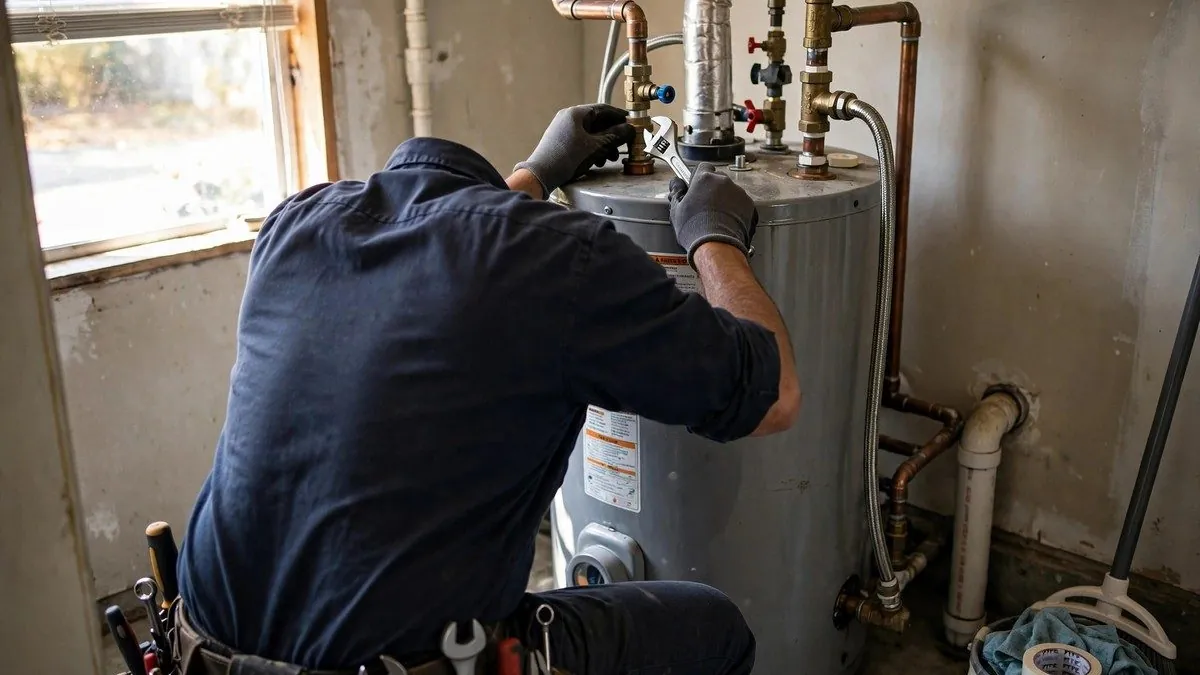
When a water heater problem is an emergency
No hot water is miserable but rarely dangerous. A water heater turns into an emergency when it is leaking steadily, when you smell gas, or when the relief valve is discharging hot water or steam. We take those calls at any hour, and same-day appointments are available for the slower problems when the schedule allows.
- If you smell gas, leave the building right away. Do not touch light switches or the phone inside. Call your gas utility or 911 from outside before you call us.
- If the tank is leaking, close the cold water shutoff valve on the pipe entering the top of the heater. If you cannot reach it, close the main water valve for the house.
- Switch the heater off. For electric units, turn off its breaker. For gas units, turn the control knob to off or pilot.
- If the relief valve is blowing hot water or steam, stay clear of the discharge pipe and do not cap it. Shut off the fuel or power and leave the valve open.
- Move stored items off the floor around the heater, then call (973) 488-5410 and tell us the heater's age, fuel type and what you see or hear.
Never plug or cap a relief valve. It is the last safety device on a tank that is holding hot, pressurized water.
Start with what the heater is telling you
A water heater usually gives clear clues before it fails completely. Lukewarm water, rumbling, a pilot that keeps going out, rust-colored hot water or a damp patch at the base each point to a different cause.
Fuel type matters first. A gas unit has a burner, a pilot or electronic igniter, a flame sensor and a gas control valve. An electric unit has two heating elements and two thermostats behind small panels on the side of the tank. The troubleshooting path is completely different for each, so tell us which one you own when you call.
Symptom, likely cause and what the repair looks like
This table covers the problems we are called for most often. It also shows where a repair makes sense and where it does not.
| What you notice | Likely cause | Typical outcome |
|---|---|---|
| No hot water, electric unit | Failed heating element, tripped high-limit reset or bad thermostat | Part replacement, usually a same-visit repair |
| No hot water, gas unit, pilot out | Dirty or failing thermocouple, weak igniter or a gas control valve fault | Cleaning or part swap, control valve is the costlier part |
| Hot water runs out fast | Broken dip tube, one dead element or heavy sediment on the tank floor | Part replacement or a tank flush |
| Popping or rumbling noise | Sediment hardened under the burner or element, trapped steam bubbles | Flush and descale if the tank is sound, replace if it is old |
| Water at the base of the tank | Loose fitting or relief valve leak (repairable) versus a tank wall leak (not repairable) | We check connections first, a leaking tank wall means replacement |
| Rust or metallic smell in hot water only | Anode rod used up and the tank lining corroding | New anode rod if caught early, otherwise replacement |
A leak from the tank body cannot be patched. If the heater is a gas unit and the flue or burner is involved, we also verify venting before we leave.
Replacing the whole heater is a different job, covered on our water heater replacement page.
Gas water heaters: pilot, thermocouple and gas valve
A standing pilot flame heats a thermocouple, a small probe that tells the gas valve it is safe to keep gas flowing. When the probe weakens or gets coated in soot, it stops sending a signal and the valve closes. The pilot goes out every time you relight it.
Newer gas units use electronic ignition and a flame sensor instead. The sensor can foul with residue and shut the burner down, and cleaning it often restores operation.
We also check combustion air, the flue draft and the venting, because a heater that backdrafts can put carbon monoxide into the home. If the gas control valve is the failed part, we compare the cost of the valve against the age of the tank before suggesting it.
No hot water or a leaking tank right now?
Call the 24/7 line, tell us the fuel type and age of the heater, and we will send a licensed plumber with a clear price before work starts.
Call (973) 488-5410Electric water heaters: elements, thermostats and the reset button
Electric tanks are simpler to diagnose. We turn off the breaker, remove the access panels and test each element and thermostat with a meter. An element that reads open has burned out, and one that reads grounded to the tank has failed internally.
A red reset button on the upper thermostat trips when the water gets dangerously hot. If it trips again after you press it, something is wrong and pressing it repeatedly is not the fix. A stuck thermostat or a shorted element is the usual reason. We replace the part, restore the breaker and confirm the water reaches a safe set temperature.
Relief valve discharge and expansion pressure
The temperature and pressure relief valve opens when water gets too hot or pressure climbs too high. A valve that drips from time to time may be telling you about thermal expansion rather than failing. When a heater heats water in a closed system, the volume increases and the pressure has nowhere to go.
An expansion tank on the cold supply absorbs that extra volume. If your home has a backflow preventer or a check valve at the meter, an expansion tank is the usual fix. Swapping the valve alone often just starts the dripping again a month later.
According to Kearny's permit page, a new or replacement hot water heater needs a zoning permit and a construction permit with the plumbing subcode. Plain repairs fall under ordinary maintenance in the state code, but ask the construction code office when you are unsure.
What affects the price of water heater repair
We give a clear price before work starts. These are the factors that decide what a repair costs.
Part availability for older or unusual models can change the timeline. Want your real number? Call (973) 488-5410 and describe the heater and what it is doing.
Signs a repair is not worth it
We would rather tell you not to spend money than sell a repair that will not last. These are the signs we look for.
- Water pooling at the base that traces back to the tank wall rather than a fitting.
- A tank old enough that tank water heaters typically run about 8 to 12 years and yours has passed that range.
- Rust-tinged hot water, with an anode rod that is gone and a lining that is already breaking down.
- Repeated repairs within a short window, especially control valve or element failures.
- A thick layer of sediment on the tank floor that flushing does not move.
If you reach that point, a tankless water heater is one option to consider, though it changes gas sizing, venting and the electrical load.
Water heaters in Kearny homes
Kearny's water comes from the North Jersey District Water Supply Commission and is distributed by the Town's Water Department, with Veolia handling billing and customer service. The 2024 water quality report lists a distribution pH between 7.0 and 8.0. It does not list a hardness figure, so ask the utility before you assume what mineral content your heater is working against.
Hardness decides how fast sediment builds on the tank floor. Across the line, Harrison's supplier reports moderately hard water, and homes there see more scale. See our Harrison plumbing page for that side of the border.
On permits, Kearny's construction code office says a new or replacement hot water heater needs a zoning permit and a construction permit with the plumbing subcode, and every permit requires an inspection. Ordinary repair of an existing heater is generally maintenance, but permit rules vary, so ask the construction code office.
What to do while you wait for a plumber
If the heater is leaking, keep the shutoff closed and place a bucket or wet vacuum under any drip. If it is a power outage rather than a failure, check the breaker before you call.
Avoid draining a hot tank. Water over about 120 degrees F can scald in seconds. If the tank must be drained for a repair, we let it cool or draw hot water through a hose to a floor drain safely. For a boiler that heats your radiators rather than a standalone tank, our boiler repair page covers that equipment separately.
Frequently asked questions
It depends on the part that failed, the age of the tank, the fuel type and how easy the unit is to reach. An anode rod or thermocouple is the lower end, and a gas control valve is the higher end. We give a clear price before work starts. Call (973) 488-5410 and describe the heater for a real number.
Yes. The dispatch line is open around the clock, and a leaking tank, a gas smell or a relief valve blowing steam is treated as an emergency at any hour. If you smell gas, leave the building and call your gas utility or 911 first. Same-day appointments cover slower problems when the schedule allows.
Usual causes are a dead heating element in an electric unit, a broken dip tube that sends cold water straight to the top, or sediment that takes up space in the tank. We test the elements and thermostats first on electric models. A flush often restores capacity, if the tank is still sound.
If the pilot has gone out once and there is no gas smell, following the label on the heater is reasonable. If it will not stay lit or goes out repeatedly, stop. The cause is usually a failing thermocouple or gas valve, and repeated relighting does not fix it. If you smell gas, do not try.
It depends on where the water comes from. Leaks at the inlet and outlet fittings, the drain valve or the relief valve can be fixed. A leak that comes through the tank wall or from under the insulation means the steel tank has corroded through, and the only fix is replacement.
The town says a new or replacement water heater needs a zoning permit and a construction permit with the plumbing subcode, and all permits require inspection. Routine repair of an existing heater is generally ordinary maintenance. Permit rules vary, so ask the construction code office if you are unsure.
It is usually sediment. Mineral scale settles on the bottom, and water trapped under it boils and pops as the burner or element heats it. A flush can clear a light layer. A thick, hardened layer on an old tank often means the heater is near the end of its life.
Not sure whether your heater needs a part or a swap? Call the 24/7 line and a dispatcher will help you sort it out.
Call (973) 488-5410