
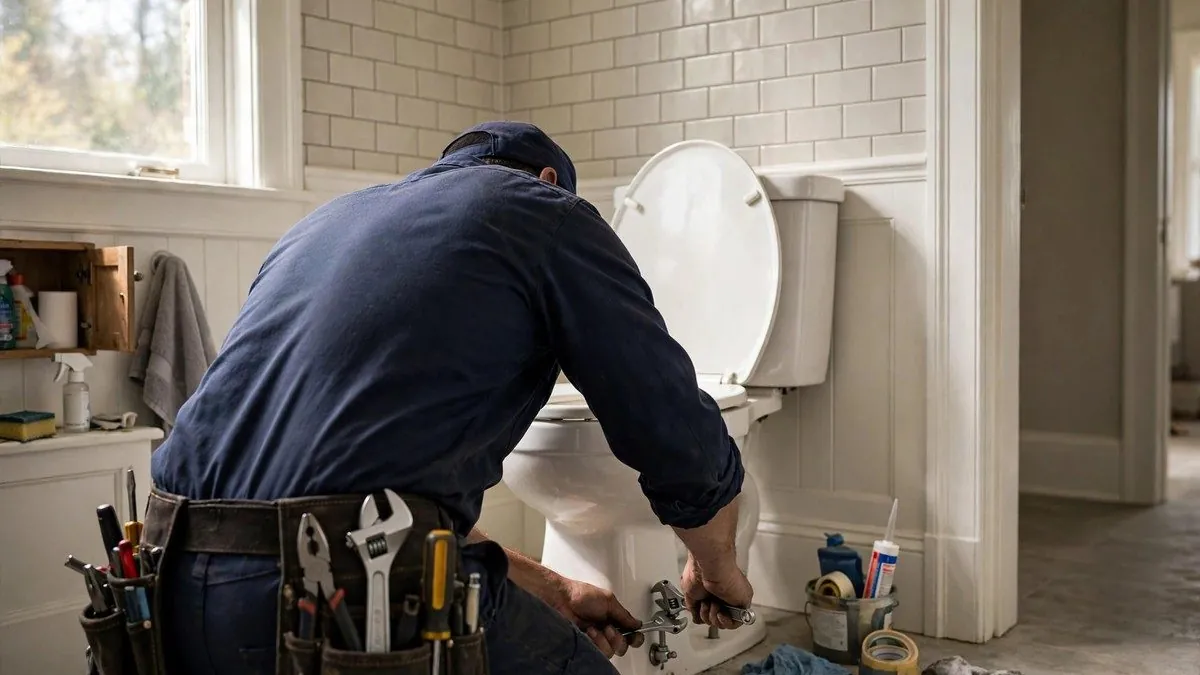
What the flange actually does
The flange is a short collar glued or bolted to the end of the drain pipe, with a flat ring on top that lies on the floor. Two closet bolts slide into slots on the ring and hold the toilet down. A wax ring or a wax free gasket sits between the toilet horn and the flange and makes the seal.
Two jobs are bundled together here. The flange anchors the toilet so it cannot shift, and it positions the outlet so the seal stays compressed. If the ring is broken, the bolts have nothing to grip. If the ring sits too low, the seal never closes. Both problems look like a leaking toilet, but the toilet itself is usually fine.
Signs the flange is the problem, not the toilet
Before you buy anything, rule out a loose supply line or a sweating tank. These signs point to the flange or its seal.
- The toilet rocks or twists when you sit down, even after the bolts are tightened.
- Water seeps out around the base after a flush, not while the tank refills.
- A sewer smell comes from the bathroom even though the trap in the sink and tub is full.
- The floor around the toilet feels soft, or the vinyl or tile is lifting nearby.
- You see rust flakes or a cracked ring when the toilet is pulled.
- A previous flange repair never held a seal for long.
A soft floor deserves attention before any flange work. Slow leaks can rot the subfloor, and a new flange needs solid wood to screw into. If the floor flexes, stop and have someone look at it.
Flange types and when each one fits
Hardware stores sell several flanges, and the right one depends on your drain pipe and how damaged the old ring is. This table covers the common choices.
| Flange type | Best for | Watch out for |
|---|---|---|
| PVC or ABS glue-on | New work or a drain pipe cut back and re-glued, 3 or 4 inch pipe | Needs the right cement and a clean cut, and it must match the pipe material |
| Cast iron | Older homes with cast iron stack, usually lead and oakum or caulked joints | Heavy, can crack, and the old joint takes skill to rework |
| Stainless steel ring | Replacing a cracked top ring while keeping the pipe | Thin ring on a bad pipe end can still leak |
| Repair ring or flange extender | Ring is damaged but pipe is sound, or floor was raised with new tile | Does not fix a pipe that is loose in the floor |
| Offset flange | Moving the toilet a short distance to clear a joist or wall | Reduces flow area, so use only when needed |
When unsure, take the old flange or a photo of it to the counter. Pipe size and material matter more than brand.
If your flange connects to lead, brass or cast iron, treat it as a plumber's job. Those joints do not behave like modern plastic.
Toilet rocking or leaking at the base?
Call our 24/7 dispatch line, (973) 488-5410. We will tell you whether it sounds like a ring, a flange or something deeper and give a clear price before work starts.
Call (973) 488-5410Replacing the flange, step by step
This is the full sequence for a glue-on flange on a plastic drain. Read it through before you start.
- Shut the water at the stop valve behind the toilet, flush, and hold the handle until the tank is empty. Sponge out what is left.
- Disconnect the supply line and remove the cover caps and nuts on the closet bolts.
- Rock the toilet gently to break the seal and lift it straight up. Set it on a towel or cardboard. Expect it to be heavy.
- Stuff a rag into the open drain to block sewer gas and keep tools from falling in.
- Scrape off the old wax. Unscrew the old flange from the floor, and cut it away if it is glued to the pipe.
- Check the pipe end. It must be round, clean and cut square. A split or oval pipe has to be cut back or repaired first.
- Dry fit the new flange. The top ring should rest on the finished floor, not below it, with the slots lined up front to back.
- Apply primer and cement to the pipe and the inside of a glue-on flange, push it on with a quarter turn, and hold for the time on the can.
- Screw the ring to a solid floor with stainless screws, set the closet bolts in the slots, and place the new wax ring.
- Lower the toilet straight down over the bolts, press firmly, tighten the nuts evenly in small turns, trim the bolts and reconnect the water.
Do not over tighten. Porcelain cracks before it complains. Let the glue cure for the time listed on the can before the first flush, then check the base after a few flushes.
Fixing a flange without cutting the pipe
If the pipe is sound and only the top ring is cracked, a stainless repair ring can bolt over the old flange. Its lower edge sits on the floor, and new screws go through the ring and old flange into the subfloor. It is a quick fix and it avoids cutting the drain.
It does not help when the flange is loose from the pipe, or the pipe has moved. If the pipe wobbles when you push the flange, the connection below the floor has failed. That is the point to stop and check what is under the bathroom, usually from the basement or crawl space.
Getting the height right
Flange height is the detail that most often ruins a good job. The top of the ring should sit on top of the finished floor. If new tile or vinyl was laid over an old flange, the ring may now sit below the floor and the wax cannot close the gap.
A thick wax ring or an extender can bridge a small gap. Stacking several wax rings is a poor fix, because they can slip and smear into the drain. For larger gaps, use a proper extender ring or reset the flange. A flange that is too high is less common but can crack the toilet horn when tightened.
If the toilet backs up in Kearny, call the right office first
A bad flange leaks at the base. A toilet that backs up or overflows is a different problem, and in Kearny the town draws a clear line. If sewage backs up into a house, call Kearny DPW at (201) 998-3700. DPW checks the main sewer line. If the main is flowing, the blockage is in the lateral and the homeowner must hire a plumber.
The property owner is responsible for maintaining and repairing the lateral sewer line. That is why a quick check with DPW before you pay for work on your own pipe is worth the call.
Source: Kearny Department of Public Works sewer backup guidance and Construction Code Enforcement page
When to hand it to a plumber
Replacing a flange on a plastic drain, on a solid floor, with the toilet over a basement you can see, is a fair DIY job. These situations are better left to a licensed plumber.
The drain is cast iron, lead or galvanized. The floor is soft or has been leaking for a while. The pipe turns out to be loose or cracked below the floor. The toilet is on an upper floor with no access from below. Or you have already reset the toilet twice and it still leaks. Our toilet repair and installation team handles all of these, and a stubborn clog that is not a flange problem falls under drain cleaning.
Permits and ordinary repair
In New Jersey, plumbing work on existing buildings generally needs a construction permit. The state lists only one exemption, ordinary maintenance, which includes routine repair. Swapping a wax ring or resetting a toilet usually falls in that category. Cutting out and replacing drain pipe may not.
Permit rules vary, so ask the Kearny construction code office if you are unsure whether your job qualifies. Neighbors in Harrison and Lyndhurst should check with their own town offices, because each sets its own process.
Frequently asked questions
The usual signs are a toilet that rocks even with tight bolts, water seeping at the base after flushing, and a sewer odor. Pull the toilet to confirm. A broken ring, rust flakes, a flange sitting below the floor or a loose pipe all mean the flange needs repair or replacement.
The top of the ring should rest on the finished floor. Tile or vinyl added later can leave it below the surface. A small gap can be bridged with a thicker wax ring or a spacer. Larger gaps call for an extender ring or resetting the flange.
Both, on a typical plastic drain. A glue-on flange is cemented to the pipe, and its ring is screwed to the subfloor. A repair ring is screwed down and bolted over the old flange. Cast iron connections use different methods and are best left to a plumber.
No. The toilet must be lifted off to reach the flange, the wax and the closet bolts. Plan on a new wax ring or seal every time the toilet is lifted. Any repair done without removing it, such as caulking the base, only hides the leak.
A standard wax ring works well on a level flange when the toilet is set once. A wax free gasket tolerates reseating and small height differences. Either works. A flat, secure flange matters more, and two seal types should never be stacked in one joint.
Call Kearny DPW at (201) 998-3700 first, because they check the main sewer line. If the main is flowing, the blockage is in your lateral, which you maintain. Then call us at (973) 488-5410 and we will clear it and tell you what we see.
Not usually, but it should not wait long. Seepage soaks the subfloor and can rot it. Turn off the water at the stop valve, keep the toilet out of use and book a repair. If sewage is spreading across the floor, treat it as urgent.
Not sure whether it is the flange, the wax or the drain? Call the 24/7 line and we will talk it through.
Call (973) 488-5410