
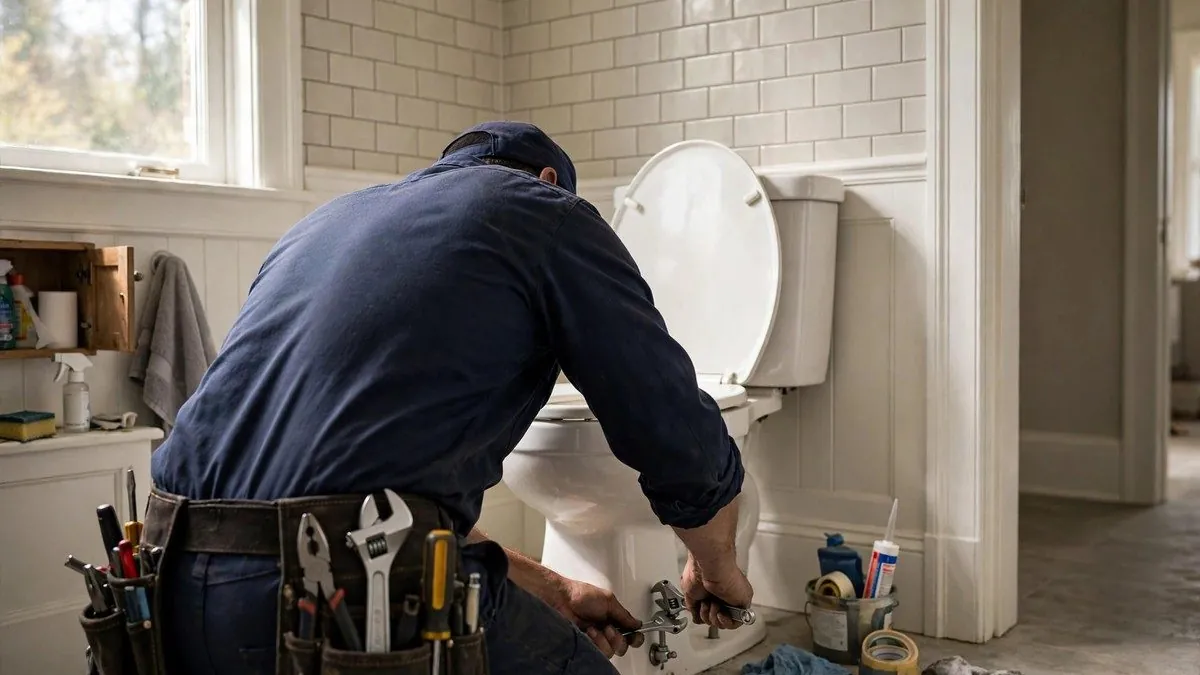
Toilet overflowing: stop the water first
A toilet overflow gets worse every few seconds, and the first minute decides how far the water travels. These steps stop it. Night or weekend, we answer the same line, and same-day appointments are available for toilets that are failing but not flooding.
- Take the lid off the tank and push the rubber flapper down to the bottom, which stops water entering the bowl.
- Turn the supply valve on the wall or floor behind the toilet clockwise until it stops. That cuts the water to the tank.
- Do not flush again. Each flush adds more water to a bowl that is already full.
- Lay towels around the base and keep children and pets away. If the water is dirty, treat it as contaminated.
- If water is coming up in the tub or the floor drain too, stop using every fixture and call us at (973) 488-5410 and Kearny DPW at (201) 998-3700.
If the supply valve will not turn, shut the main valve where water enters the house.
Reading what the toilet is telling you
Most toilet trouble falls into a few patterns. Water at the floor around the base points to a failed wax ring or a loose closet bolt, not a cracked bowl. Water dripping from the tank bottom means a worn tank gasket or loose tank bolts. A tank that keeps refilling is leaking past the flapper.
A bowl that rises slowly and drains with a gurgle has a clog in the trap or the line beyond it. Knowing which one you have saves a wasted trip, so describe the symptom when you call.
Common toilet problems and the usual repair
This table matches what you see to the part that has usually failed and the typical fix.
| What you see | Likely cause | Typical repair |
|---|---|---|
| Water on the floor at the base | Failed wax ring or loose closet bolts | Pull the toilet, replace the wax ring, reseat and shim it level |
| Tank refills every few minutes | Worn flapper or a bent chain | Replace the flapper and adjust the chain |
| Hissing or a tank that will not stop filling | Fill valve failed or float set too high | Replace the fill valve and set the water level |
| Weak flush | Mineral buildup in the rim jets or a low tank level | Clean the rim holes and reset the water level |
| Rocking bowl | Uneven floor or a loose flange | Shim the bowl or repair the closet flange |
| Bowl fills and will not clear | Clog in the trap or the line | Auger the toilet or clear the branch drain |
A general guide. We confirm the cause at the toilet and explain it before we repair.
Why a toilet rocks and what happens to the floor under it
A rocking toilet is more than an annoyance. Every shift squeezes the wax ring a little, and eventually it lets water or sewer gas past. Slow leaks at the base soak the subfloor, which in older bathrooms can soften plywood or rot boards around the flange.
When we pull a toilet, we look at the subfloor and the flange. A flange that sits below the finished floor, or one that is cracked or corroded, needs a repair ring or a replacement before the toilet goes back. Skipping that step is why some toilets leak again within a year.
Toilet overflowing or leaking now?
Close the supply valve behind the bowl and call the 24/7 line. We will send a plumber and give you a clear price before work starts.
Call (973) 488-5410Clogs: plunger, auger and when to stop
A flange plunger, the kind with a rubber sleeve, works better on toilets than a flat cup. Seal it over the drain hole and push and pull with steady strokes. A closet auger reaches farther and does not scratch the porcelain, which a coat-hanger will.
If the water does not drop after a few honest tries, stop. Forcing it can push a clog deeper or crack the trap. A toilet that clogs again and again may have a main line problem, so see our guide to drain cleaning to learn what repeated backups mean.
Signs a toilet should be replaced instead of repaired
A repair is the better answer for most toilets, and we will say so. These are the situations where replacement makes more sense.
- A crack in the bowl or tank, even a hairline, that weeps water.
- A glaze that has worn rough, trapping waste so the bowl never looks clean.
- A toilet that clogs often despite a clean drain, a sign of poor flush design.
- Parts that are no longer made, so every repair is a workaround.
- Water use that bothers you, since older tanks use much more per flush than current models.
For a new unit, we haul away the old toilet, set a new wax ring and check for leaks at the supply and base. If you also want a new fixture elsewhere in the room, see plumbing installation.
When a toilet backup is really a sewer problem in Kearny
If the toilet backs up and the tub or a basement floor drain does too (a pattern we also see in Harrison basements), the problem is likely beyond the bowl. Kearny's town guidance says to call DPW at (201) 998-3700 to check the main sewer line. If the main is flowing, the blockage is in your lateral, and the property owner has to hire a plumber.
That is the point where a toilet repair call turns into a drain job. We will tell you which one it is on the phone if we can, and on site if we cannot, so you do not pay for a toilet repair on a line problem.
Setting a new toilet is plumbing work governed by the National Standard Plumbing Code, 2024 edition, according to Kearny's code office. Replacing a fixture in the same spot is often simple, while moving it raises permit questions.
Installing a new toilet: what the job involves
A new toilet is not just a swap. We shut off the supply, drain the tank, disconnect and lift the old bowl, scrape off the old wax, inspect the flange, install a new wax ring or seal, set the new bowl, tighten the closet bolts evenly and connect a new supply line.
Fit matters. Toilets have a rough-in distance, measured from the wall to the center of the drain, and the new bowl has to match. Round or elongated bowls and standard or comfort height are choices we will go over, along with the flush type, so the toilet works with your drain and your space.
What affects the price of toilet repair and installation
We give a clear price before work starts. These are the things that move it.
Water damage from an overflow is often a separate insurance question, so check your policy. Want your real number? Call (973) 488-5410 and describe what the toilet is doing.
Overflowing toilet: what to do while you wait
If the overflow has stopped, leave the supply valve closed and use another bathroom. Mop up with towels and open a window to help the floor dry. Do not run a fan across wet sewage, since it spreads spray.
If the toilet is only running or hissing, closing the supply valve stops the waste of water and gives you time to schedule. Our dispatch can usually set up a same-day visit when the schedule allows, and the after-hours line is open if it gets worse overnight.
Frequently asked questions
It depends on the part that failed, whether the flange and floor need work and, for a new toilet, which model you pick. A flapper or fill valve is the low end, resetting a toilet with a new wax ring is in the middle and a full installation is higher. We give a clear price before work starts.
Yes. The dispatch line at (973) 488-5410 is open 24 hours a day, seven days a week. An overflowing toilet or a leak that is soaking a floor is treated as an emergency at any hour. Slower problems, like a running tank, can get a same-day appointment when the schedule allows.
Most often the wax ring has failed because the toilet has loosened or rocked. Sometimes the closet bolts are loose or the flange is damaged. Tightening the bolts rarely fixes it for long. The reliable repair is to lift the toilet and replace the seal.
We suggest not to. Chemicals can sit in a full bowl, splash on whoever works on it next and attack older fittings. A flange plunger or a closet auger is safer, and if neither works, call a plumber.
A worn flapper that leaks into the bowl is the usual cause. Water drops in the tank, so the fill valve opens to refill it. Add a few drops of food coloring to the tank. If color shows in the bowl without flushing, the flapper needs replacing.
Permit rules vary, so ask the construction code office. State code requires a permit for plumbing work on existing buildings and lists ordinary maintenance, including routine repair, as the exemption. Replacing a flapper is maintenance. Moving a drain is not.
If only one toilet is affected, it is the fixture or its branch. If several fixtures back up, call Kearny DPW at (201) 998-3700 to check the main. If the main is flowing, the lateral is yours and we can clear it. See sewer line cleaning.
Not sure whether it is the toilet or the line? Call the 24/7 line and a dispatcher will help you sort it out.
Call (973) 488-5410