
Pressure-balance or thermostatic: choosing the valve
Most homes have a pressure-balance valve. A spool or disc inside reacts to a pressure drop on either supply line, such as a toilet flushing, and shifts to keep the ratio of hot to cold steady. It protects against sudden scalding, but the temperature still depends on where you set the handle.
A thermostatic valve senses the actual mixed temperature with a wax or bimetal element and holds it near your setting even when supply pressure or heater temperature changes. It usually has a second control for volume, so one valve can run several outlets such as an overhead head, a hand shower and body sprays.
Valve types side by side
The right choice depends on how many outlets you want, your budget and how much wall depth the framing gives you.
| Valve type | How it controls temperature | Good fit | Watch for |
|---|---|---|---|
| Pressure-balance | Balances pressure between hot and cold | Single showerhead, standard remodel, tight budget | Does not hold a set temperature if the water heater setting drifts |
| Thermostatic | Senses mixed water temperature and corrects it | Multiple outlets, households with children or older adults | Costs more and needs a separate volume control and more wall space |
| Two-handle mixing valve | Hot and cold are set by hand on separate stems | Older tubs and period bathrooms | No scald protection unless a separate device is added |
Whatever you pick, buy the valve body and trim from the same maker, because rough valves and trim kits are rarely interchangeable.
Planning the rough-in before you open the wall
Every valve comes with a rough-in sheet that gives the depth from the stud face to the center of the valve body, the height of the outlet ports and the spacing of the supplies. Follow it to the quarter inch, because the trim plate has to sit flush with the finished wall, whether that is tile over backer board or a fiberglass surround.
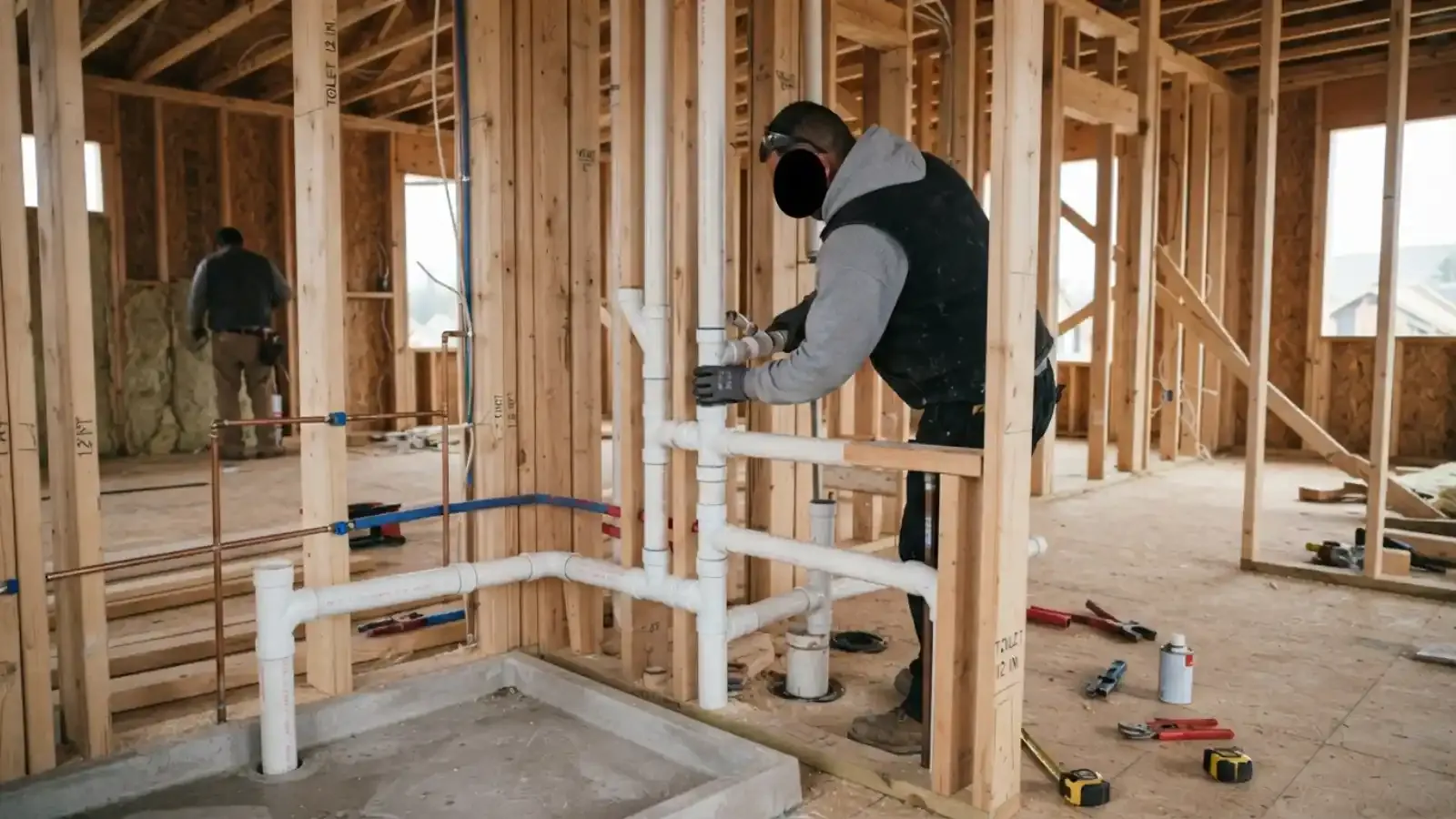
Mark the valve center at a height you can reach from outside the spray, often around the mid-chest. Then decide where the showerhead arm and the tub spout will land, because the outlet pipes are fixed once the wall is closed. Add a stud-to-stud mounting bracket or a blocked board so the valve cannot move when you turn it.
Opening a shower wall soon?
Call the 24/7 dispatch line and we will talk through the valve, the wall and the permit before you buy parts.
Call (973) 488-5410Tools and materials for the rough-in
Collect everything before you shut the water off, so the house is not without service while you shop.
- The valve body with its rough-in sheet, plus a matching trim kit and any cartridge it needs.
- Copper tubing and fittings, or PEX tubing with crimp or expansion fittings, sized to match the valve ports.
- A tubing cutter, a deburring tool, and a torch with lead-free solder and flux if you are working in copper.
- Two shutoff valves for the new branch if there is nothing upstream to isolate it.
- A drop-ear elbow for the showerhead and a stub-out or elbow for the tub spout, firmly strapped to blocking.
- A test cap or plug set, so you can pressurize the new lines before the wall is closed.
A shower pan or tub drain is a separate trade job. If the drain is being moved, the work widens beyond the valve, and plumbing installation by a licensed plumber is the safer route.
Soldering copper or running PEX
Copper is rigid, tolerates heat well and has a long track record. Soldering it takes practice. Pipe must be cut square, cleaned bright, fluxed and heated evenly until solder is drawn into the joint. Too little heat gives a cold joint that weeps later, and too much heat scorches flux and fails to wet the pipe.
PEX is faster, bends around corners and survives a hard freeze better than copper. Expansion fittings and crimp rings need the correct tool and a gauge to confirm each joint. On many valves, soldering directly to the body can damage internal parts, so check whether the maker wants stub-outs soldered first or provides threaded or sweat adapters.
Order of work from supply to finished wall
The sequence matters because mistakes are cheap to fix before drywall and expensive after. A typical order follows.
- Shut off the water, drain the branch, and open the wall to expose studs and existing supply lines.
- Install blocking at the valve and at each outlet location.
- Set the valve body to the rough-in depth and fasten it to its bracket.
- Connect hot to the left port and cold to the right port, unless the manufacturer's markings show otherwise.
- Run the outlet pipe up to the showerhead drop-ear elbow and down to the tub spout stub, and strap each run.
- Cap the outlets, restore water and pressure test with the valve open, watching every joint for a bead of moisture.
- Leave the test in place for the time the maker requires before you close the wall.
Leave an access panel when you can
The cartridge inside any valve eventually wears out, and the valve body may need service. A tiled shower with no access means cutting through tile to reach a fault. Where the back of the valve opens onto a closet, hallway or adjacent room, a removable panel behind the wall saves a repair later.
If there is no rear access, keep the trim plate larger than the hole you may need, and note the model number so the right cartridge can be ordered when it is time.
Kearny water and permits for this work
Kearny's water comes from the Town of Kearny Water Department, which buys all of it from the North Jersey District Water Supply Commission. Veolia handles meter reading and billing at 570 Elm Street. The 2024 report lists a distribution system pH range of 7.0 to 8.0, so the water is not unusually aggressive to copper fittings.
In New Jersey, plumbing work on existing buildings needs a construction permit, and the only listed exemption is ordinary maintenance, which includes routine repair. Replacing a cartridge is repair. Moving a valve, adding outlets or running new supply is generally more than that. Rough piping and final fixture inspections apply on one- and two-family homes, and permit rules vary, so ask the Kearny construction code office.
Source: Kearny Water Department 2024 Consumer Confidence Report, Kearny construction code page and NJ Uniform Construction Code summary
What affects the cost of a shower valve job
We give a clear price before work starts. The price moves with these drivers more than with the valve itself.
For a real number on your bathroom, call (973) 488-5410 and tell us what the wall is made of and what valve you have in mind.
When to call a plumber instead
Replacing a worn cartridge or a trim kit is within reach of many homeowners. Cutting into a wall, soldering inside a closed cavity, relocating a valve or tying into old galvanized supply is where mistakes cause hidden leaks. A weeping joint inside a wall can rot framing for months before a stain shows.
If the shower already leaks behind the tile, our notes on leak detection explain how we trace it without tearing out the whole wall. Homeowners in nearby Harrison and North Arlington often have the same older supply lines, so the same advice applies.
Frequently asked questions
A pressure-balance valve reacts to pressure swings and keeps the hot and cold ratio steady, but you set the temperature by feel. A thermostatic valve senses the mixed water temperature and holds it near the setting. Thermostatic valves handle more outlets and cost more.
Often yes. Many valves let you remove the trim, the stop and the retaining clip and pull the cartridge from the front. Shut off the water first, note how the old cartridge sits, and bring it to the supplier to match the make and model.
Use the rough-in sheet that comes with your valve. It gives a depth range from the stud face to the valve center so the trim sits flush on the finished wall. Cement board or tile adds thickness, so measure the final wall before you set the body.
Both work. Copper is rigid and long lived but takes more skill and a torch near framing. PEX is faster and tolerates freezing better, but it needs the correct tool for each fitting type. Check the valve maker's instructions, because some bodies should not be soldered directly.
Plumbing work on existing buildings needs a construction permit, and the only listed exemption is ordinary maintenance, which includes routine repair. A like-for-like cartridge swap is repair, while new supply runs usually are not. Permit rules vary, so ask the Kearny construction code office.
That usually means the valve does not balance pressure, or the cartridge is worn. Older two-handle valves have no balancing at all. A new pressure-balance or thermostatic valve fixes the swing, and (973) 488-5410 reaches us if you want it checked.
Kearny buys its water from the North Jersey District Water Supply Commission, and the 2024 report shows a pH range of 7.0 to 8.0. Mineral buildup and sediment can still foul cartridges over time, so a service every few years helps regardless of town.
Planning a bathroom remodel and unsure where the shower valve fits? Call the 24/7 line and a dispatcher will walk through it with you.
Call (973) 488-5410