When a water service line failure is an emergency
A service line fails quietly at first. It becomes urgent when water is surfacing, when pressure drops to a trickle, or when a basement wall is seeping where the line comes in. Those calls go to the front of the schedule at night and on weekends, and same-day appointments are available for a slow leak that can safely wait.
- Close the main shutoff valve inside the house, usually on the wall nearest the street. Turn the handle until it stops.
- Open one cold tap on the lowest floor to drain the pipes and relieve pressure, then leave it open.
- Read the water meter and write the numbers down. If they keep climbing with the valve closed, the leak is ahead of your valve.
- If water is coming up in the street or sidewalk, or you cannot reach your valve, call Veolia at (201) 955-7406. Nights and weekends that number reaches a 24/7 answering service.
- Call us at (973) 488-5410 and tell us where the line enters the building and where the wet ground is.
Do not dig on your own. A shovel through a wet yard is a common way to hit a gas line or a cable that nobody marked.
Telling a service line leak from a plumbing leak inside
The meter is the dividing line. Close the main valve inside the house and watch the meter dial. If it stops, the leak is in your house plumbing. If it keeps turning, water is escaping between the meter and the valve, or the meter itself is the problem.
Outside signs help too. A soft, green or constantly damp strip of lawn that runs toward the street, a sinkhole forming in the soil, or a faint hiss near the foundation all point to the buried line. If you have none of these but your bill has climbed, leak detection pinpoints the loss without trenching the whole yard.
Spot repair, sleeve or full replacement
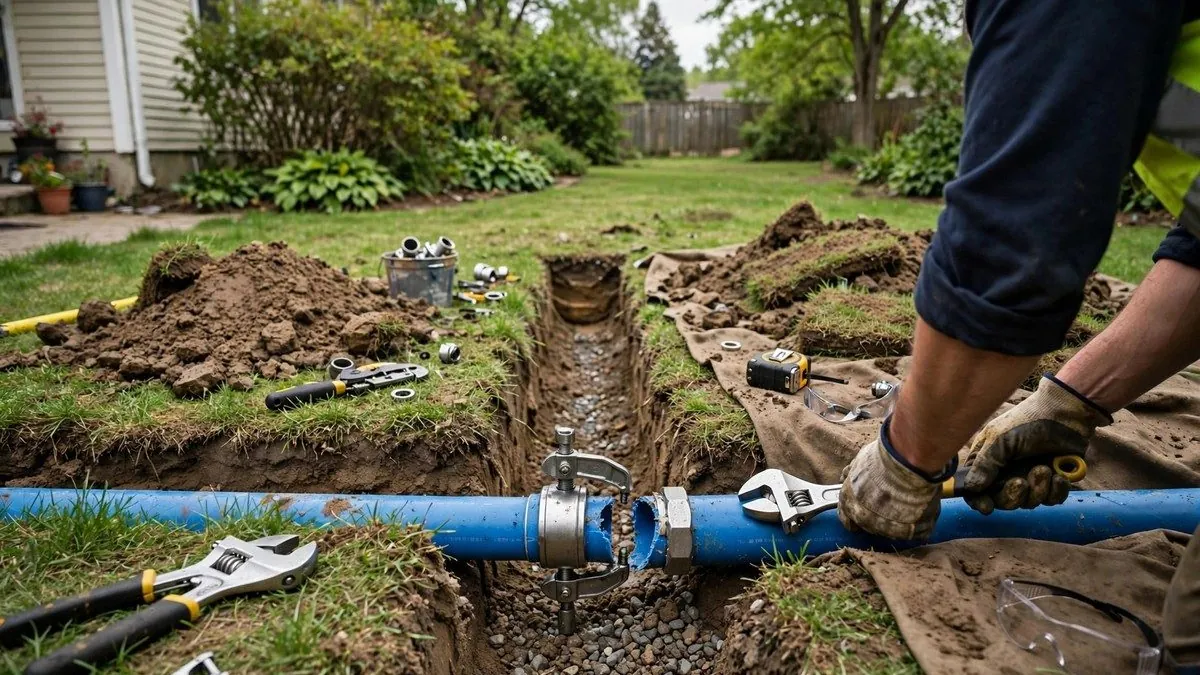
Not every failed line needs to be dug up from the street to the basement. The right fix depends on what failed and how much of the pipe is in the same condition.
| What we find | Usual repair | Trade-off |
|---|---|---|
| One pinhole or a split at a single spot on otherwise sound pipe | Cut out the bad section and splice in new pipe with approved fittings | Quickest and least digging, but a second failure nearby is possible on old pipe |
| Several leaks or pitted pipe along the run | Replace the whole line with new copper or PEX | More digging, but you stop repairing the same pipe every year |
| Lead or galvanized steel line | Replace the line, not patch it | Higher cost than a splice, but a patch leaves the old material in the ground |
| Line fails right at the foundation wall | Replace the entry section and the wall sleeve | Needs careful sealing so groundwater does not follow the pipe inside |
Line material and the number of failed spots decide the repair. We show you the damaged section and give a clear price before work starts.
Trenchless methods such as pipe bursting exist, but they need space at both ends and suit long, straight, deep runs. For short residential lines, a trench is often the simpler and cheaper option.
Why buried water lines fail
Galvanized steel rusts from the inside until the opening narrows and the wall thins. Copper can develop pinholes where soil chemistry or stray electrical current attacks it. Old lead pipe seldom bursts, but its joints and connections can weep. Plastic fails differently, usually at a fitting or where a rock has pressed on it for decades.
Freeze damage is its own category. A line laid too shallow, or one that passes through an unheated crawlspace or garage wall, can crack when the ground and air get cold enough. If a frozen line is the problem, thaw it carefully and have it inspected afterward, since a split pipe leaks only once the ice melts.
Water surfacing in the yard right now?
Close your main valve and call the 24/7 line. We will explain the next steps and give you a clear price before work starts.
Call (973) 488-5410Lead lines and Kearny's service line inventory
The Town of Kearny Water Department posts a lead service line inventory with an address lookup tool on its water department page. Lines marked Lead or Galvanized Requiring Replacement are prioritized, and lines listed as Unknown are treated as possibly lead until someone verifies the material. State records for the system list thousands of lead or possibly-lead service lines, most of unknown material.
The town's 2024 water report advises flushing the tap before drinking where a lead service line is present. Look up your address first, and if the line is listed as lead or unknown, mention it when you call. Questions about the town's replacement program go to Neglia Engineering at (201) 842-2135 ext. 440. We repair your side, and coordinating with the town on its program is part of the job.
According to the Kearny Water Department, the lead service line inventory is posted with an address lookup, and lines marked lead or galvanized requiring replacement are prioritized. Work on the line follows the National Standard Plumbing Code, 2024 edition.
Who owns which part of the line
In most towns the water utility owns the main in the street and the connection to it, while the property owner owns the pipe from there to the building. Where exactly the ownership line falls varies, so we do not assume it. Ask the Town of Kearny Water Department or Veolia before you pay for work near the curb.
Kearny's water comes from the North Jersey District Water Supply Commission, delivered through the town's distribution system, with Veolia handling billing and customer service. A main break, a broken hydrant or a street leak is theirs to fix. If the leak is on the building side of the connection, it is yours, and we do that repair.
What affects the price of water service line repair
We give a clear price before work starts. These are the factors that move it most on a buried water line.
Emergency timing can change the labor rate, and we state it before we start. Want a real number for your yard? Call (973) 488-5410 and tell us what you see.
Signs your service line is going
Most failures give warning. These are the signs worth acting on before the line lets go in the middle of the night.
- Water pressure that has dropped across the whole house, not just at one tap.
- Brown or rust-colored water after the house has been unused for a few hours.
- A water bill that jumps with no change in how many people live in the house.
- A patch of lawn that stays wet or sunken in dry weather.
- The sound of running water at night when every fixture is closed.
If two or more of these match, call before the next freeze. A line that already has pinholes is more likely to split when it gets cold. Related problems inside the walls are covered under burst pipe repair.
Permits and the dig itself
New Jersey's Uniform Construction Code requires a construction permit for plumbing work on existing buildings, and the only listed exemption is ordinary maintenance, which includes routine repair. Whether a full line replacement counts depends on the scope, so ask the Kearny construction code office. Permit rules vary, and all permits in town require an inspection.
Lyndhurst's code is a useful comparison. It requires service connections to be laid at least 3.5 feet deep and wants proof of lead service pipe replacement for a Certificate of Occupancy. That is Lyndhurst law, not Kearny's, but it shows what inspectors in this area look for. Before any trench goes in, the utilities are marked, and the new line is pressure tested before backfill.
Frequently asked questions
It depends on the length of the failed run, what sits on top of it, how deep it is buried and which pipe goes in. A spot repair costs less than a full replacement. We give a clear price before work starts, and you can call (973) 488-5410 to describe what you see.
Yes. The dispatch line is open 24 hours a day, seven days a week, and a line that is flooding a basement or has left the house without water is handled as an emergency at any hour. Slower leaks get a same-day appointment when the schedule allows.
Close your main valve. If the meter keeps turning or water is surfacing in the street, call Veolia at (201) 955-7406. A leak between the connection and your house is typically the property owner's. Ask Veolia or the town water department where ownership changes for your address.
Use the address lookup tool on the Town of Kearny Water Department page, which lists the line material. Lines marked Unknown are treated as possibly lead until verified. If it is lead or unknown, flush the tap before drinking, as the town's report advises.
Often yes. A thawing machine can warm the pipe from inside the house or at the meter. The danger is a hidden split that only leaks once the water flows again, so we check the line and the meter area afterward.
A trench is usually needed, so some lawn and soil will be disturbed. We keep it to the narrowest path that works and talk through restoration before we start. Driveways and walks add complexity, and we explain the options on site.
New Jersey requires construction permits for plumbing work on existing buildings, with an exemption for ordinary maintenance such as routine repair. A full replacement may not qualify as routine, so ask the Kearny construction code office. Permit rules vary, and permitted work is inspected.
Not sure whether the leak is yours or the town's? Call the 24/7 line and we will help you sort it out.
Call (973) 488-5410