
Where basement water actually comes from
Water enters a basement in a few ways. Groundwater presses on the foundation and finds its way in at cracks, the joint where the wall meets the floor (the cove joint) and gaps around pipes. Surface water arrives from poor grading, short downspouts and window wells that fill. Condensation forms on cold walls and pipes in humid weather.
The fourth cause is plumbing: a leaking supply line, a weeping drain or a failed water heater. People often start with the biggest answer, but it is smarter to start with the cheapest question. Is this water coming from my own pipes?
Rule out plumbing and condensation first
Before paying for a waterproofing system, spend an hour on these checks. They cost almost nothing.
- Note your meter reading, shut off every fixture for an hour and check it again. Movement means a leak.
- Tape a square of aluminum foil tightly to a damp wall for a day. Moisture on the room side means condensation. Moisture under the foil means water through the wall.
- Look for stains below pipes, water heaters, laundry boxes and washing machine hoses.
- Check whether the dampness follows a rain event or appears with no weather at all.
- Smell for sewage, which points to a drain or lateral issue, not groundwater.
If the meter moves with fixtures off, call for leak detection before anything else.
Interior drain, sump, sealant and exterior work compared
These are the usual approaches. Notice that they work in different ways and fall to different trades.
| Approach | What it does | Who typically handles it |
|---|---|---|
| Interior perimeter drain | Collects water at the base of the wall and carries it to a sump pit | Plumber or basement specialist |
| Sump pit and pump | Collects water and pumps it out to a safe discharge | Plumber |
| Crack injection and sealing | Closes a specific crack against seepage | Waterproofing or masonry contractor |
| Interior sealers and paint | Reduces dampness and efflorescence on masonry, but does not stop pressure | Homeowner or painter |
| Exterior excavation and membrane | Exposes the foundation to seal it and install a drain tile | Excavation or waterproofing contractor |
| Grading, gutters and downspouts | Moves roof and surface water away from the foundation | Landscaper, roofer or homeowner |
Many houses need more than one. The cheapest items, gutters and grading, are worth fixing first.
We describe the plumbing items on this list in detail below, and we will tell you plainly when the right fix is outside our trade.
How an interior perimeter drain works
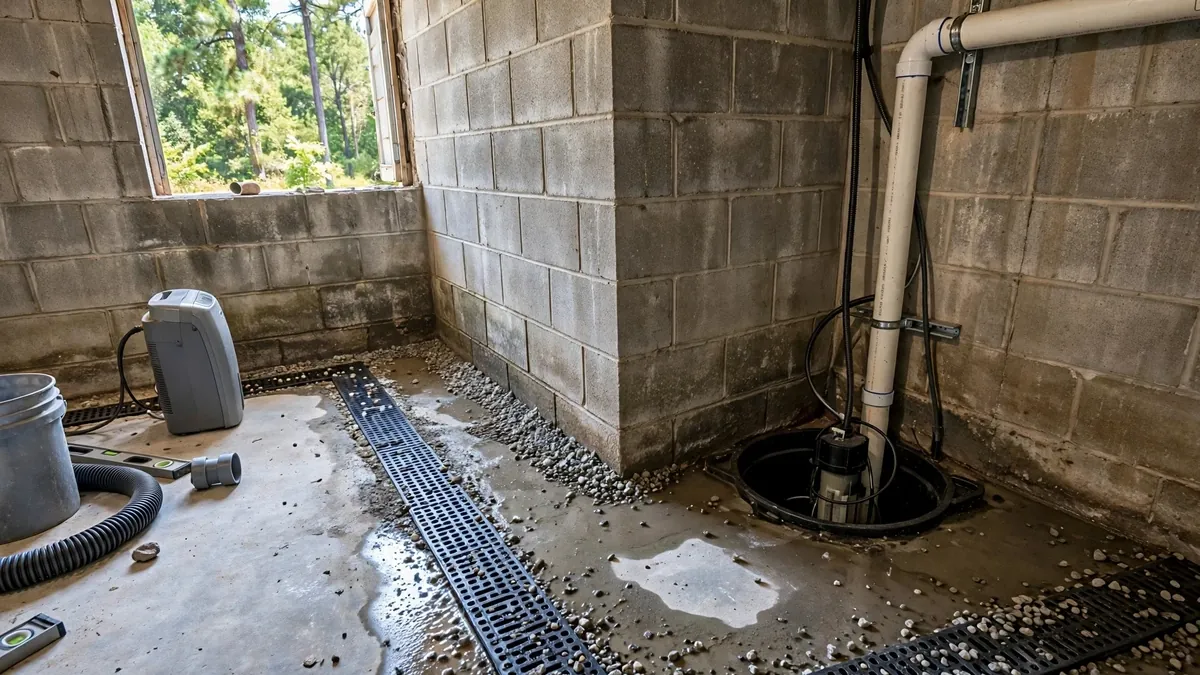
A perimeter drain is a channel cut along the inside edge of the basement floor, along the wall. A perforated pipe, often called drain tile, sits in gravel in that channel and slopes to a sump pit. New concrete covers it, and a wall flashing or baffle directs any water running down the wall into the channel.
It does not stop water from entering the foundation. It gives water somewhere to go before it reaches the floor, and then a pump moves it out. That is why a drain is only as good as the pump and the discharge route that goes with it.
Wet basement and not sure why?
Call the line and describe where the water appears. We will tell you whether it is a plumbing job and give a clear price before work starts.
Call (973) 488-5410Sump pits and pumps
A sump pit is a basin, usually 18 to 24 inches across, set below the floor level. A submersible pump sits at the bottom with a float switch that turns it on as water rises. A check valve in the discharge line keeps pumped water from running back in.
For anything important, we suggest a pump on a GFCI protected outlet, a high water alarm and a battery backup, since sump pumps tend to work hardest when storms and outages overlap. Our sump pump installation and repair page covers sizing, replacement and the signs of a tired pump.
Sealers, paint and what they cannot do
Masonry sealers and waterproof paints are sold in every hardware store. They can slow dampness, stop chalky white deposits and reduce a musty smell on dry-ish walls. They cannot hold back water under pressure, and they often peel when it pushes through from behind.
We say this because it is the most common waste of money we see described. If the wall is truly wet, use a drain or an exterior fix. If it is just damp, a sealer plus better gutters might be all it needs.
What a plumber does and does not do
We handle interior water management: perimeter drains, sump pits and pumps, discharge piping, backwater valves and the plumbing connections around them. We can help you decide whether those fit your basement.
Exterior excavation, foundation membranes, major crack repair in structural walls and regrading are usually done by another trade. If your problem needs that, we will say so and help you describe it to a contractor. We do not promise a basement that is perfectly dry in every condition, and neither should anyone else.
According to the Lyndhurst township code, stormwater and unpolluted drainage may not go into the sanitary sewer. Kearny's rule is not in our verified sources, so ask the construction code office before you route a sump discharge.
Gutters, grading and other cheap fixes
Many wet basements improve with simple outside work. Downspouts should discharge several feet away from the foundation, not at the wall. The ground should slope away from the house. Gutters should be clear, and window wells should drain or have covers.
These changes cost little compared with a drain system. They also help the system you install later work less. Nothing on this list is a plumbing job, and any of them is worth trying before an interior drain.
Low ground and drainage near the rivers
Kearny sits beside the Passaic and Hackensack rivers with Meadowlands wetlands to the east. As a general matter, low-lying property near rivers and wetlands drains slowly after heavy rain, and a sump pump may run more often there. We cannot tell you the groundwater depth at your address, and we do not make claims about it. A contractor can check the soil at your site.
Know where your sump discharges. Lyndhurst's township code, for example, bars stormwater and unpolluted drainage from the sanitary sewer, and other towns have similar rules. Ask the construction code office before connecting a sump to any drain. For a nearby view, see our Lyndhurst page.
What affects the price of basement water control
We give a clear price before work starts. The cost of interior water control depends on the following.
Interior systems cost more than gutters and sealers, but far less than excavation in most cases. Want to talk through your basement? Call (973) 488-5410 and describe where the water shows up.
Questions to ask any contractor
Whoever you hire, a few questions reveal how honest the plan is.
- What is the source of the water, and how did you decide?
- Where will the pumped water discharge, and is that allowed in this town?
- What happens if the power goes out during a storm?
- Is the permit included, and who schedules the inspection?
- What part of this is not covered by your trade, and who handles it?
If a sewer line is involved, a sewer camera inspection separates groundwater from a leaking lateral.
Frequently asked questions
A plumber can manage water inside: perimeter drains, sump pits and pumps, discharge piping and backwater valves. Exterior excavation, foundation membranes and regrading are usually handled by other trades. We tell you which category your problem falls into.
It depends on how much perimeter needs a drain, the number of sump pits, the pump and backup you choose, the discharge route and the floor condition. We give a clear price before work starts. Call (973) 488-5410 and describe your basement.
A sump pump removes water that reaches the pit. It does not prevent water from entering the foundation, and it needs a drain or a path that leads to the pit. A working pump with a backup power source is the part that matters most.
Neither is better in every case. Exterior work addresses water at the wall and costs much more because of the digging. Interior work manages water that gets in. Which fits depends on the house, the access and the budget.
No. Condensation, plumbing leaks and surface water from gutters and grading are all common. Try the foil test and a meter check before spending on a drain system.
Permit rules vary, so ask the construction code office. Where the sump discharges also matters, because many towns do not allow stormwater in the sanitary sewer. We help you route it properly.
Not sure if your wet basement is a plumbing problem? Call the line and describe what you see.
Call (973) 488-5410