
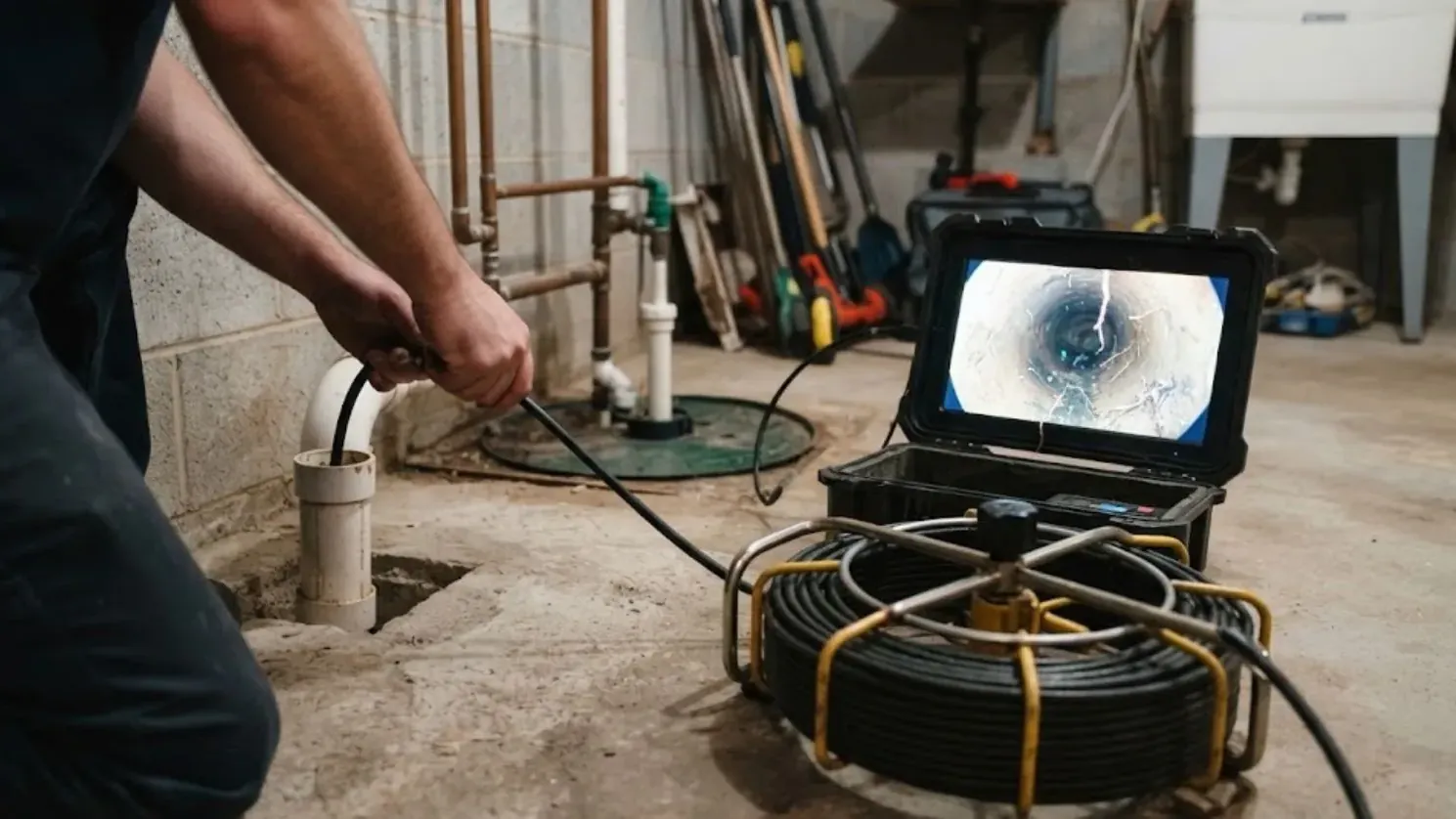
What the camera actually shows
The camera head is a small waterproof lens with its own lights, mounted on a flexible push rod that runs through a reel. We feed it into the line through a cleanout or a pulled toilet and watch a monitor as it moves toward the street. A distance counter on the reel tells us how far down each problem sits.
That number matters. A crack at 12 feet from the cleanout is a very different repair from a crack at 55 feet, and the footage is what lets us plan the dig, or decide that no dig is needed.
Good reasons to book an inspection
You do not need to wait for a backup. These are the situations where a camera run saves more than it costs.
- You are buying a house with a sewer lateral nobody can describe, and you want facts before closing.
- A drain has been cleared more than once and keeps slowing down again.
- A cable keeps stopping at the same spot, which may be a break, an offset joint or a root mass.
- You are planning a basement bathroom or a new fixture and want to know the line can carry it.
- There is a sewer smell, a soft patch in the lawn or a sunken slab near the line.
- The house is older and the pipe material is unknown.
If the line is already running slow, drain cleaning usually comes first so the camera can pass, then we inspect the cleared pipe.
What we find on the monitor and what it usually means
Every pipe material shows its age differently. This table lists the findings we see most and the plain-language meaning of each.
| On the monitor | Likely cause | Typical next step |
|---|---|---|
| Fine hairlike roots at a joint | Open joint in clay or old cast iron letting moisture out | Cut the roots, then watch the line on a schedule |
| Thick root ball filling the pipe | Long-term intrusion through a cracked or separated joint | Clear it, then price a spot repair or a liner |
| Standing water in a low stretch | Belly or sag where the pipe settled | Measure its length, decide between monitoring and replacing that section |
| Flaking, rough, rust-colored walls | Scale buildup inside cast iron | Hydro jetting or descaling, and a replacement conversation if walls are thin |
| Pipe ends that do not line up | Offset joint or crushed section | Spot dig repair, since cleaning will not fix it |
| Clean, round pipe with steady flow | Healthy line | Record it and move on |
Footage is a record of the day, not a promise about next year. A clean line today can still pick up roots later.
Many of these findings are handled without opening the whole yard. Our page on sewer line repair describes how a spot repair or liner works.
How the visit goes, start to finish
We start by finding the access point. Most houses have a cleanout near the foundation wall or in the basement floor. If there is none, we remove a toilet and go in through the closet flange. We say that before we begin so no one is surprised.
The camera goes in, we watch the monitor and call out what we see as we go. At the street end, a locator can mark the camera's position above ground when depth or a connection is unclear.
Afterward we back the camera out, wipe down the work area and show you the recording. If something needs attention, we explain the options in plain terms and price them before you decide.
Want to see inside your sewer line?
Call the line to schedule a camera inspection. We will confirm the access point, explain what to expect and give a clear price before work starts.
Call (973) 488-5410Who is responsible for the lateral in Kearny
Kearny's public works page says the property owner is responsible for maintaining and repairing the lateral sewer line. The town's DPW, at (201) 998-3700 on Bergen Ave, checks the main sewer line when sewage backs up. If the main is flowing, the blockage is in the lateral and the owner must hire a plumber.
A camera inspection is how you learn what condition that owner-maintained pipe is in before it becomes an emergency. Some low-lying parts of town use sanitary pumping stations because waste will not flow by gravity, and in South Kearny and part of the Meadowlands the sewers belong to the Kearny Municipal Utilities Authority, not DPW. Not sure who serves your address? Ask us or the town.
According to Kearny's DPW, the town checks the main sewer line when a house backs up, and the lateral belongs to the owner. A camera report gives you the facts for both conversations and for any repair under the National Standard Plumbing Code, 2024 edition.
Inspections before you buy or sell
A general home inspector looks at fixtures and visible piping. Most do not run a camera down the lateral, and a lateral can fail with no sign above ground. If you are a buyer in an older part of town, we suggest asking for a camera run during the inspection period.
Sellers sometimes order one first. A recording that shows a sound line is a useful document. A recording that shows a problem lets you price a repair on your schedule instead of in the middle of a closing.
Lyndhurst has its own rule here. The township code requires owners to replace the sewer lateral and connect to the main on new construction or major residential renovation, so check our Lyndhurst page if the property is across the line.
Pipe types and what the footage looks like
Cast iron, common in houses built before about 1960, shows rough, flaky walls and sometimes tubercles, which are rust bumps that narrow the bore. Clay pipe shows its joints every few feet, and roots love them. Orangeburg, a pressed wood fiber pipe used in some mid-century work, can look soft, oval or collapsed.
PVC and ABS plastic look smooth and white or black. Their problems are different, usually a bad connection, a sag from poor bedding or damage from earlier digging. Knowing the material is half of the diagnosis, and the camera tells us that for sure.
What affects the price of a sewer inspection
We give a clear price before work starts. The same visit can cost more or less depending on a few real conditions.
An inspection usually costs far less than a repair, and often prevents buying the wrong one. Want a real number for your address? Call (973) 488-5410 and tell us about the house.
Getting ready for the camera visit
A little preparation keeps the visit short.
- Show us the cleanout, or tell us if you have never seen one.
- Clear a path to the basement floor drain or the bathroom we may need to work in.
- Tell us about past problems, such as backups, roots or earlier repairs.
- Avoid running large loads of laundry or long showers during the visit.
- If you are buying, send us the inspection deadline so the visit fits it.
For lines that need regular maintenance after a camera run, hydro jetting cleans the pipe walls rather than just opening a hole.
What a camera cannot tell you
A camera shows the inside surface and the position of the pipe. It does not show the soil around it, and it cannot tell how many years remain. It also cannot see past a full blockage or a collapse.
If a line is crushed, the camera stops there and we say so, because a repair plan then depends on a dig or a second method. We would rather tell you the limit than hand you a recording that looks complete.
Frequently asked questions
A typical house lateral takes under an hour on site once we have access. Clearing a blockage first, finding a hidden cleanout or locating the line above ground can extend that. We tell you what we expect when you call.
Price depends on access, the length of the run and whether the line must be cleared first. We give a clear price before work starts, and you can call (973) 488-5410 with the address and a description of the problem for a real number.
Not always. If you are buying an older house, planning a renovation or have had repeat clogs, it is worth it. A healthy house with no history of trouble can reasonably skip it.
Usually yes. We can enter through a toilet flange or a roof vent in some cases. We will also tell you if installing a cleanout is a good idea, since it makes every future visit easier and cheaper.
Yes, we can save the footage and note the distance and type of each finding, so you can share it with a buyer, a lender or another contractor. Ask when you book and we will plan for it.
The camera can show where the lateral meets the main, but the main belongs to the town. If sewage is backing up, call Kearny DPW at (201) 998-3700 so they can check the main, then we inspect the lateral.
We explain what we see, what the realistic repair options are and what each costs relative to the others. Sometimes the right answer is to watch the line and clean it on a schedule. We do not push a dig you do not need.
Planning a purchase or a renovation and unsure if you need a camera run? Call the line and we will talk it through.
Call (973) 488-5410