
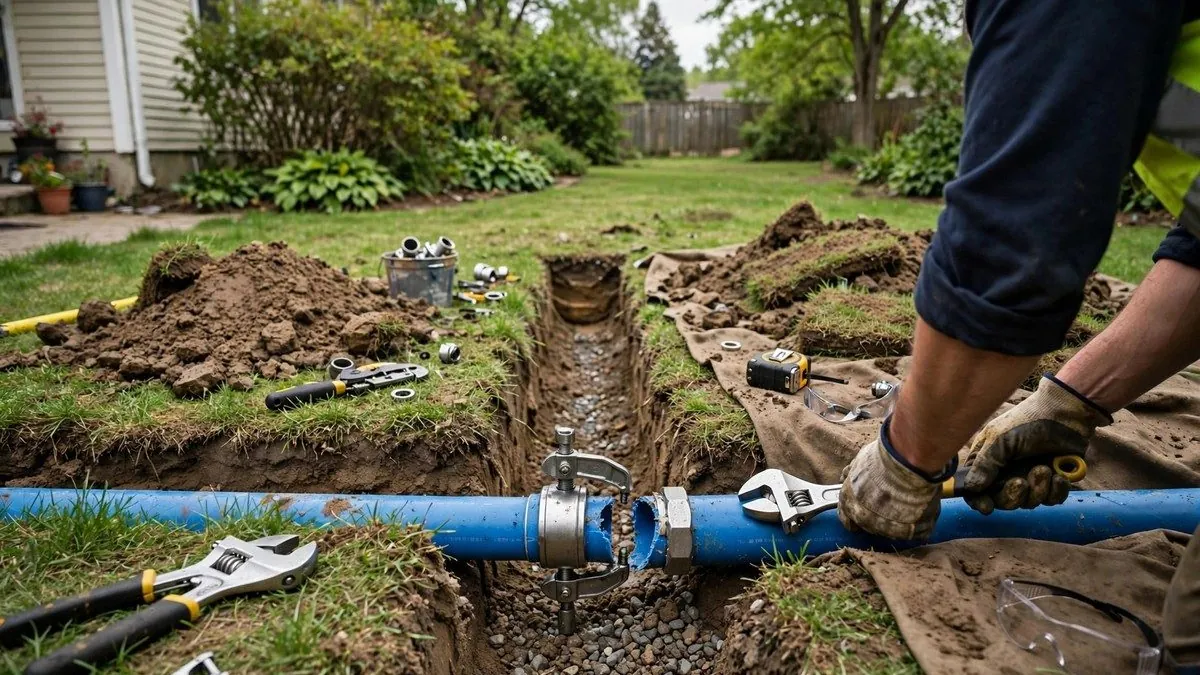
What the buried water line is
The water service line runs from the utility main under the street, through a shutoff near the curb or property line, across your yard or sidewalk, and into the house at the meter and main valve. Its pressure is always on, so a small hole leaks all day and night.
That constant pressure is what separates it from a sewer lateral problem. A sewer pipe leaks only when water is draining through it, and a buried supply line leaks whether anyone is home or not.
Signs that point to a leak outside the house
No single sign proves it, but these combine into a convincing picture.
- A water bill that climbs with no change in how many people live in the house
- The meter dial or low-flow indicator moves when every tap and appliance is off
- A patch of soil that stays soggy, or grass that is greener and faster-growing along one line, in dry weather
- A sunken area, a crack in a walkway or driveway, or a wet spot on a basement wall where the line enters
- Lower water pressure all over the house, or a hissing sound near the main valve
- Water that runs discolored or muddy after a quiet period
Wet ground on its own can also be a sump issue, a gutter downspout or a drain, so confirm with the meter test before digging up anything.
The meter test you can do tonight
This is the most reliable homeowner check, and it takes about thirty minutes. Make sure nothing in the house is using water. That includes the ice maker, the washing machine, the dishwasher, the humidifier, the irrigation system and any softener that might be regenerating.
Find the meter, usually in the basement near where the line enters, and read it. Look for the small low-flow indicator, a triangle or wheel that spins when even a trickle passes. If it moves, water is flowing somewhere. Write down the reading, wait thirty minutes with everything still off, and read it again. Any change means a leak.
Meter moving with everything off?
Call (973) 488-5410 and tell us what the meter test showed. We will say honestly whether it sounds like a buried line or something inside.
Call (973) 488-5410Inside leak or outside leak: closing the valve
To see which side of the main valve the problem is on, close the main shutoff inside the house and watch the meter. If the dial keeps moving with the valve closed, water is escaping between the meter and the main valve or before the meter. If it stops, the leak is inside the house and the meter is behind it.
That sorts the problem. A leak that stops with the valve closed is somewhere in your piping, perhaps a toilet flapper, a dripping fixture or a pipe in a wall. A leak that continues points to the buried line or the connection at the meter.
How leaks are located without digging
Excavating blindly through a driveway is expensive and often misses. Several methods narrow the search first, and plumbers often combine two of them.
| Method | How it works | Best for |
|---|---|---|
| Acoustic listening | A ground microphone or contact sensor picks up the hiss of pressurized water escaping | Metal pipe, where sound carries along the line |
| Pressure test | The line is isolated and gauge drop shows loss and its rate | Confirming a leak exists in the buried section |
| Tracer gas | A safe gas mix is injected and a sniffer follows it to the surface | Plastic pipe, which carries sound poorly |
| Thermal imaging | A camera shows warm or cold spots on a slab or wall | Hot water lines and slab leaks |
| Line locating | A transmitter traces the route of the buried pipe | Finding where the line actually runs before any digging |
Our leak detection service uses the method that fits the pipe material and surface above it.
Who to call in Kearny and what the town says about lead lines
Kearny's water system is operated by the Town of Kearny Water Department. Veolia's Municipal Water Division, at 570 Elm Street, handles meter reading, billing and customer service under contract. The town buys all of its water from the North Jersey District Water Supply Commission, which draws mainly from the Wanaque and Monksville Reservoirs.
For water main breaks, leaks in the street, broken hydrants or service disruptions, call Veolia at (201) 955-7406. Weekdays 8 am to 4 pm go to the office, and nights, weekends and holidays go to a 24/7 answering service. Billing and meter questions go to 1-800-242-5695.
The town also posts a lead service line inventory with an address lookup tool on its water department page. Lines marked lead or galvanized requiring replacement are prioritized, and lines marked unknown are treated as possibly lead until verified. If your line is dug up for a leak repair, ask which material you have, and flush the tap before drinking where a lead line is present.
According to the Kearny Water Department, lead service line status is available through the inventory lookup on its page, which is a useful companion to a leak search.
Source: Town of Kearny Water Department page and 2024 Consumer Confidence Report, and NJ Water Check.
Who owns which section of pipe
Generally the utility maintains the main in the street, and the property owner maintains the service line from the curb shutoff or property line to the house. The exact dividing point varies by utility, so ask Veolia or the water department where responsibility ends on your property before you pay for a repair on the wrong side of it.
A leak in the street near the curb stop is the utility's concern. A break under your front walk, lawn or driveway is usually the homeowner's. If you are unsure, make the Veolia call first. It costs nothing, and they can often tell you from the meter and the shutoff location.
What to do while you wait for repair
Close the main valve if water is surfacing or the basement wall is wet. Keep a record of the meter reading, the time and photos of any wet ground. Do not let anyone dig without first having the line located, because the same area may hold gas, electric and sewer lines. In New Jersey, the 811 service marks underground utilities for free before excavation.
If water is pooling against the foundation, move valuables off the basement floor. Pooled water can also seep into the house through cracks, so see our notes on sump pumps if you have one.
Repair options once the leak is found
A short break can be cut out and fixed with a repair coupling. If the line is old, corroded or leaking in several places, replacing the whole run is often wiser than patching one spot at a time. Replacement can be done by trenching or by trenchless methods that pull a new pipe through the old path, depending on what is above it.
Our water service line repair page explains both. Because lead lines are being identified across town, a repair is also a good time to ask whether the line should be replaced with a non-lead material rather than patched.
Frequently asked questions
The meter keeps moving after you close the main valve inside the house, or pressure drops and the ground stays wet in dry weather. A leak inside the house stops showing on the meter once that valve is closed.
Yes. A buried pipe under pressure leaks constantly, and the meter counts that water even though you never see it. A bill that rises with no change in habits is one of the first signs.
Call Veolia at (201) 955-7406 if the leak is in the street or at the curb shutoff, or if you are unsure which side it is on. Call us at (973) 488-5410 for a leak on your side, and we can pinpoint it.
Coverage varies a lot. Some homeowner policies cover sudden water damage but not the pipe itself, and some offer a service line add-on. Read your policy or ask your agent before the repair begins.
Not usually. Acoustic, tracer gas and line-locating methods find the break within a short stretch, so the excavation can be a small hole rather than a long trench. Replacement of an old line may still need a trench or a trenchless pull.
The meter test works the same anywhere, but the utility to call differs. Harrison has its own water department and Lyndhurst buys water from neighboring systems, so ask your own utility where its responsibility ends.
Not sure whether the meter is telling you what you think? Call the 24/7 line and we will walk through the test.
Call (973) 488-5410