
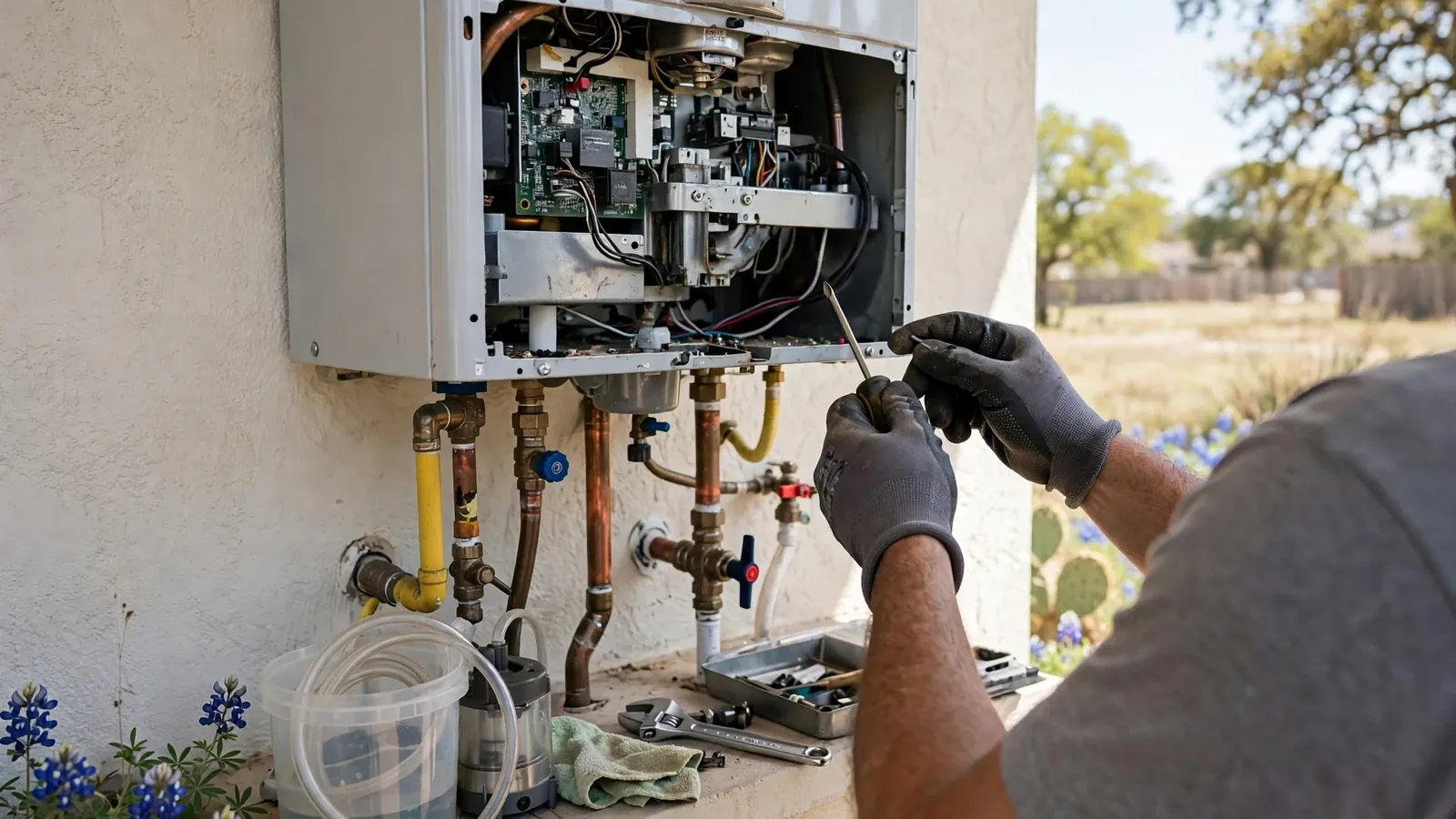
How a tankless heater differs from a tank
A tank heater keeps thirty to eighty gallons hot around the clock. A tankless unit fires a burner or electric elements only when flow is detected, heats the water as it passes through a heat exchanger, and shuts off when the tap closes.
That has two practical results. You get a long run of hot water, but only as much per minute as the unit can heat. And the unit needs a lot of energy for a short time, so the gas line or electrical service has to be able to deliver it.
Sizing: flow rate and temperature rise
Sizing comes down to two numbers. The first is flow, in gallons per minute, for the fixtures you might run at the same time. A shower is often around two gallons per minute, a kitchen faucet about one and a half, and a dishwasher or washing machine adds more.
The second is temperature rise, the difference between the incoming cold water and the hot water you want. Cold ground water in winter can be near forty degrees, so reaching one hundred twenty degrees takes a bigger rise and more output. A unit that is fine in summer can run out of capacity on a January morning.
Which house conditions favor tankless
Tankless is not automatically better. This table compares common situations.
| Situation | Tankless usually fits | Pause and think |
|---|---|---|
| Hot water demand | Steady, moderate use or a large tub filled in one go | Several showers and the laundry running at once may exceed the unit's flow |
| Space | Wall-mounted unit frees up floor area in a basement or closet | Venting and clearances can eat the space you hoped to save |
| Gas supply | A modern gas line sized for the full load | Older half inch lines often need upsizing |
| Water quality | Softer water, or a softener or scale filter in place | Hard water scales the heat exchanger and shortens life |
| Replacement plan | A tank near the end of its roughly 8 to 12 year life | Replacing a young tank early rarely saves money |
A site visit confirms each of these for your house. See our tankless water heater service for details.
Planning a tankless install?
Call (973) 488-5410 and we will ask about your gas line, vent path and hot water use, then give a clear price before work starts.
Call (973) 488-5410Gas line capacity, the step most people skip
A tank heater might burn a modest amount of gas. A tankless unit sized for a whole house can demand several times as much at full fire. If the gas line from the meter was sized for a stove, a dryer and a small tank, it may not deliver enough, and the unit will then shut down or run weak.
A plumber adds up the load of every gas appliance, measures the pipe length and size, and checks whether the line needs to be enlarged. This is the first thing we confirm, because a unit that cannot get enough fuel is a very expensive disappointment.
Venting a tankless unit and the air it needs
Most gas tankless units are sealed combustion appliances and exhaust through plastic or stainless pipe, either straight out a side wall or up through the roof. The vent must slope correctly, keep clear of windows and meters by the distances the manufacturer and code require, and be sealed at every joint.
An old chimney flue is generally not a good fit for the cooler exhaust of a condensing unit. Venting a unit incorrectly risks carbon monoxide entering the home, which is why it should be inspected, and why a working CO alarm belongs near the sleeping area either way.
Permit, inspection and water quality around Kearny
Kearny's Construction Code Enforcement says a new or replacement hot water heater needs a zoning permit and a construction permit with the plumbing subcode. Plumbing plans must follow the National Standard Plumbing Code, 2024 edition, and all permits require an inspection. The front office is at (201) 955-7880, Monday to Friday, 8 am to 4 pm.
The town says typical processing is about 7 business days for small jobs and 5 to 7 for complex ones, with up to 20 working days allowed. A gas or vent change may involve other subcodes, so ask the construction code office what applies to your house.
On water quality, the 2024 Kearny report lists no hardness figure, so ask the water department. Nearby Harrison's supplier measured hardness of 84 to 100 ppm in 2023, which is moderately hard, while Belleville's report lists 48.7 ppm, which is soft. Hardness drives how often a heat exchanger needs descaling.
Source: Kearny Construction Code Enforcement page, Kearny 2024 and Harrison and Belleville Consumer Confidence Reports.
What to do before the installer arrives
A few small steps make the day go faster and keep everyone safe, especially because a tankless unit usually involves a gas line and a vent.
- Clear a path from the door to the install spot and move stored items away from the old heater.
- Find the main water shutoff and the gas shutoff, and tell the installer where each one is.
- If you smell gas at any point, leave the building and call your gas utility or 911 before anyone touches the unit.
- Keep children and pets out of the work area, because pipes and vents stay hot after the old unit is drained.
- Have the model label, or a photo of it, ready for the installer, along with any permit paperwork.
Tankless installation day, step by step
The plumber shuts off water and gas and drains the old heater if there is one. The old unit comes out, and the new one is hung on the wall, usually on a plywood backer fastened to studs, with the right clearances for service access.
Next come the gas line and shutoff valve, the vent run, the condensate drain on condensing models, the cold and hot water connections, and a set of isolation valves with service ports. A pressure relief valve discharge pipe is run to a safe spot. Then the unit is powered, purged of air and fired up for a combustion check.
Descaling and long-term care
Minerals in water bake onto the inside of the heat exchanger over time, narrowing the passages and cutting efficiency. The fix is descaling, which means circulating a mild acid, usually white vinegar or a descaling solution, through the unit with a small pump for 45 to 60 minutes through the service ports.
How often depends on hardness. Many manufacturers suggest yearly service in hard water areas, and longer intervals where water is softer. Cleaning the inlet screen filter and checking the vent and condensate drain are part of the same visit.
Why this is not a DIY project
Gas piping, venting and a heat exchanger that runs at high temperature are not forgiving. In New Jersey, plumbing work must be done by a master plumber or an authorized plumbing contractor, and the permit and inspection are part of that. Ask any plumber for their license number and check it with the state board.
If you want a standard tank unit instead, see water heater installation. Homeowners in Harrison and Belleville ask the same questions, though their water suppliers differ.
Frequently asked questions
In New Jersey, plumbing work must be done by a master plumber or an authorized plumbing contractor, and the work needs a permit and inspection. Gas and venting errors are also safety hazards, so this is a job to hire out.
It depends on your use and your house. A tankless unit saves floor space, can supply hot water for a long time and often lasts longer than a tank, but it costs more to install. It is best when the gas line and vent path are easy to upgrade.
Often yes. A whole-house tankless unit can draw much more gas at once than a tank heater. The plumber totals all gas appliances, measures the existing pipe and tells you whether it needs upsizing.
Often once a year in hard water, and less often in soft water. The interval comes from the manufacturer's instructions and your local water hardness, which your water department or utility can tell you.
Yes. The town says a new or replacement hot water heater needs a zoning permit and a construction permit with the plumbing subcode, and all permits require an inspection. Ask the construction code office about gas or venting changes.
It gives continuous hot water but not unlimited flow. Run too many fixtures at once, or have very cold incoming water, and the unit may not keep up, so sizing for peak demand matters.
Weighing tank against tankless? Call the 24/7 line and describe your house, and we will give you an honest view.
Call (973) 488-5410