
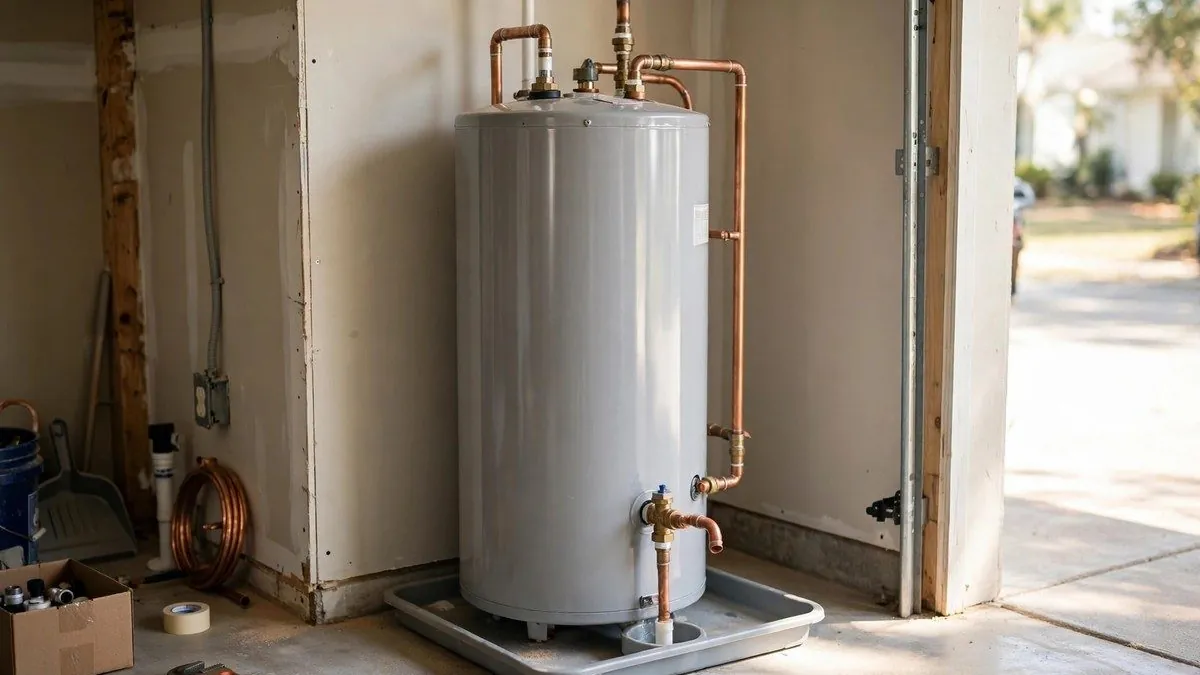
Planning a water heater installation, decision by decision
A good installation starts with four decisions made in order. First, the fuel, which is usually decided by what the house already has. Second, the type, such as a standard tank, a power-vent tank or a heat pump unit. Third, the size. Fourth, the location.
Making these choices before the old heater fails gives you the best options. You can compare efficiency, ask about warranty terms and plan the work for a day that suits you. Emergency swaps tend to be like-for-like, because there is no time to rework piping or a vent.
Tank types and fuels compared
No single type is best for every house. This table shows how the common options differ.
| Type | Strengths | Trade-offs |
|---|---|---|
| Gas, atmospheric vent | Simple, low upfront cost, works with a chimney | Needs a good draft and combustion air |
| Gas, power vent | Vents through a side wall with plastic pipe | Needs electric power and a wall penetration |
| Electric tank | No venting, simple installation | Can cost more to run where electricity is expensive |
| Heat pump electric | Uses much less electricity than a standard electric tank | Needs clearance, airflow and a condensate drain |
| Tankless | Endless hot water and saves floor space | Higher upfront cost and often a larger gas line |
Tankless units are a different job, so see tankless water heater for sizing and venting details.
Sizing: first-hour rating matters more than gallons
A tank's gallon number is only part of the story. The first-hour rating tells you how much hot water it can deliver in the first hour of heavy use, counting both the stored water and what it heats on the way. That figure is on the yellow energy label.
To size well, we ask how many people live in the house, how many bathrooms you have and when most showers happen. A household that runs a dishwasher, a washer and several showers at once needs more than a couple that rarely overlaps. Oversizing wastes energy and floor space, and undersizing means cold showers.
Permits and inspection for a new water heater in Kearny
According to Kearny's construction code office, a new or replacement hot water heater needs a zoning permit and a construction permit with the plumbing subcode, and every permit requires an inspection. Plumbing must follow the National Standard Plumbing Code, 2024 edition. The permit fee is set by ordinance.
Processing time is typically about 7 business days for small jobs, and up to 20 working days are allowed. That is a good reason to plan ahead. The front office is at (201) 955-7880, weekdays from 8 am to 4 pm. In New Jersey, only a master plumber or authorized plumbing contractor may do the work, and you can ask any plumber for the license number.
The National Standard Plumbing Code, 2024 edition, is the code Kearny's construction office says plumbing plans must follow. Relief valves, drain lines and expansion control are the kind of details an inspector checks on a water heater, as a general matter.
Planning a new water heater?
Call (973) 488-5410 to schedule a visit. We will look at the space, talk through sizes and fuel, and give you a clear price before work starts.
Call (973) 488-5410Venting, gas and combustion air
A gas water heater makes carbon monoxide, and the vent carries it outside. The vent must slope upward, be sized for the unit and have no gaps. A heater that backdrafts, which means exhaust spills back into the room, is a serious hazard. We check the draft before and after the new unit goes in.
Combustion air matters too. A heater in a tight closet needs openings or ducted air so the flame gets enough oxygen. Gas supply piping needs a sediment trap and a shutoff valve at the unit, and every joint is tested for leaks. If your house has a CO alarm, test it when the work is complete.
Expansion tanks, relief valves and drain pans
When water heats, it expands. In a house with a check valve or pressure reducing valve at the meter, the extra volume has nowhere to go, and pressure can rise. A small expansion tank on the cold line absorbs it. Many installations need one, and we check your pressure to decide.
The temperature and pressure relief valve is the last safety device. Its discharge pipe must run down to a safe spot, not be capped or threaded. Where a leak would damage a finished space, a drain pan with a drain line is added under the tank.
How to prepare for install day
A few steps from you make the visit faster and smoother.
- Clear a path from the door to the heater, including the stairs, and move stored items away from the unit.
- Know where the main water shutoff is and that it works. Tell us if it sticks.
- Decide what you want done with the old tank. We remove it for you.
- Let us know about any plans to remodel the area, which could change where the heater should sit.
- Plan for the water to be off for a few hours, and fill a few jugs for the morning.
If the shutoff valve is seized, we will tell you before the work begins and quote the valve replacement with the rest of the job.
What installation day looks like
We confirm the permit is in hand, shut off the water and the fuel or power, and drain the old tank. The old unit is disconnected and carried out. We check the piping and replace connectors, valves and the discharge pipe where needed.
The new tank is set level, connected and filled. We purge air from the lines, light the burner or restore power and test the temperature. After that, we explain the settings, show you the shutoff valves and leave the area clean. The inspector then visits to sign off on the work.
What affects the price of a water heater installation
We give a clear price before work starts. A planned job lets us itemize each part so you see where the money goes.
Choosing a more efficient unit can lower your running costs, but the payback depends on your use, so we help you weigh it. To plan your install and get a clear price, call (973) 488-5410.
Switching fuel, upsizing, and when not to bother
Not every upgrade is worth it. A heat pump water heater can save real energy, but it wants a room with clearance and air, and it cools the space around it. In a small, closed closet it often performs poorly. A gas-to-electric switch may need a new circuit and a larger panel.
Upsizing makes sense if the household has grown. It does not make sense just because bigger sounds better. If your current unit meets your needs and only needs a swap, a like-for-like install is the simplest and quickest route. If the old tank has already failed, see water heater replacement.
Water quality and older homes around Kearny
Homes built before about 1960 often have galvanized supply piping, and it can be crusty inside. When we disconnect a heater, we look at those pipes and flag any that will not hold. Kearny's mills and housing date to the late 1800s and early 1900s, so older plumbing is common, but we confirm house by house.
If you are in North Arlington, your water comes from the Passaic Valley Water Commission, and in Kearny it is bought from the North Jersey District Water Supply Commission. Ask your utility about hardness, because it affects how fast sediment builds in a tank.
Frequently asked questions
A straightforward swap of a tank for a tank usually takes a half day, plus time for the new unit to heat. Changing fuel, adding a vent or moving the heater takes longer. We give a time frame after we see your setup.
It depends on the unit, whether the fuel or vent changes, where the heater sits and what code items are required. We give a clear price before work starts. Call (973) 488-5410 to schedule a visit and get your number.
Yes. The town's construction code office says a new or replacement water heater needs a zoning permit and a construction permit with the plumbing subcode, and each permit requires an inspection. We handle the paperwork and the inspection appointment.
Size depends on the number of people, the bathrooms and your daily peak use. Check the first-hour rating on the energy label, not only the gallon count. Tell us your household and habits and we will recommend a size.
In New Jersey, plumbing work must be done by a master plumber or an authorized plumbing contractor, and a permit and inspection are required. A gas unit adds real risk from leaks and venting errors. We recommend a licensed plumber.
It can be, in a room with enough space and airflow, such as a basement. It uses far less electricity than a standard electric tank. It is a poor fit for a small closed closet. We check the space before recommending one.
We drain it, disconnect it and haul it away as part of the job. You do not need to arrange disposal. If you prefer to keep it for some reason, tell us before the visit.
Have a question that is not covered here? Call the dispatch line and a plumber will go through your options.
Call (973) 488-5410