
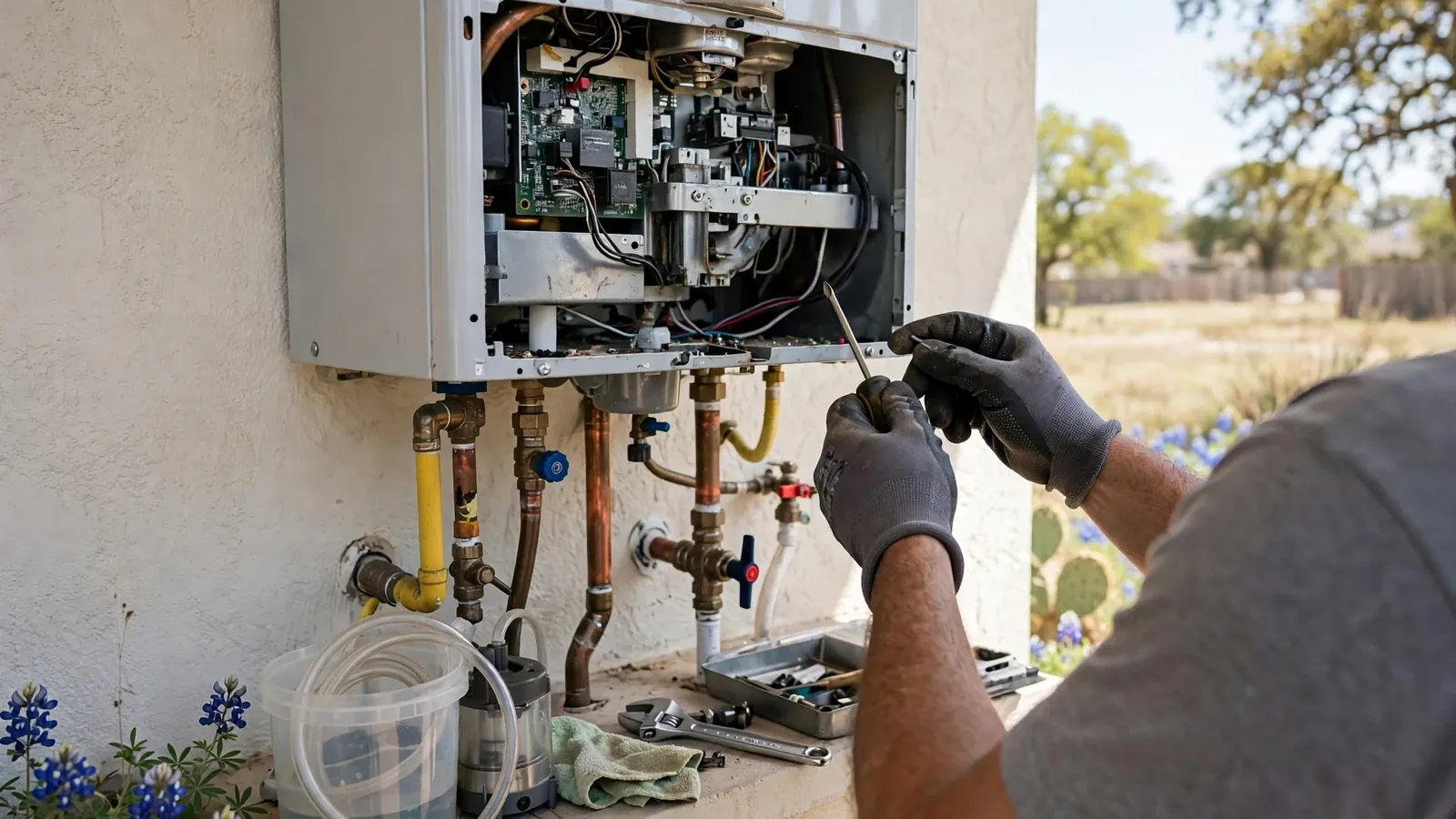
How an on-demand heater makes hot water
When you open a hot tap, a flow sensor in the unit sees water moving and fires a gas burner or switches on electric elements. Cold water passes through a heat exchanger and leaves hot. Close the tap and the unit shuts off.
The key number is temperature rise, the gap between incoming water and the temperature you want. Cold winter water coming in needs a bigger rise than summer water, so the same unit delivers fewer gallons per minute in January than in July. Good sizing is done for the coldest month, not the average one.
Tankless or tank: how the two compare
Neither type wins every time. This table covers the differences that actually change the decision for a household.
| Question | Tankless | Tank |
|---|---|---|
| Hot water supply | Continuous while flow stays within the unit's limit | A fixed volume, then a wait to recover |
| Standby heat loss | None, because nothing is kept hot | Constant, a tank reheats itself through the day |
| Upfront work | Often larger, with new venting, gas piping or electrical service | Usually a straight swap in the same spot |
| Space | Wall mounted, frees up floor area | Needs a floor footprint and drain access |
| Typical service life | Often 15 to 20 years with descaling | Roughly 8 to 12 years |
| Hard water impact | Scale in the heat exchanger needs periodic flushing | Sediment collects at the tank bottom |
A general comparison. Your gas supply, vent route and household size decide which one is right.
Sizing by flow rate, not by gallons
A tank is sized by how much it holds. A tankless unit is sized by how many gallons per minute it can heat to the right temperature while several fixtures run together. Add up what could run at the same time, such as a shower, a dishwasher and a kitchen tap, and match that to the unit's rating at your temperature rise.
Undersizing is the most common mistake. A unit that is fine for one shower may fade when a second bathroom starts up. If your house has a large soaking tub or body sprays, tell us up front, because those fixtures can eat most of a small unit's output on their own.
What has to be ready before a tankless unit goes in
The unit itself is the easy part. These are the items that usually decide the scope of the job.
- Gas line capacity. Gas tankless units draw much more fuel at once than a tank heater, and an old half inch line often has to be upsized.
- A vent path to the outside. Condensing units use plastic pipe through a wall, non-condensing units need stainless or special-grade vent.
- A condensate drain for condensing models, since they produce acidic water that must be neutralized and drained.
- Electrical supply. Even gas units need an outlet, and electric tankless models can need heavy dedicated circuits that a small panel cannot give.
- Space on the wall with working clearance around the unit and an accessible shutoff valve on each line.
If the gas line or panel needs work, we say so in the plan before anything is ordered. A cheaper unit that needs an expensive utility upgrade is not always the better deal.
Planning a tankless upgrade?
Call the 24/7 line and tell us about your house, your fixtures and your current heater. We will walk through sizing and give a clear price before work starts.
Call (973) 488-5410Gas, electric and what each asks of your house
Gas tankless units give the highest flow rate and are the usual choice for a whole house. They need venting, a gas line sized for the burner and combustion air. Electric units have no flue, which makes them easy to place, but a whole-house electric model draws a lot of power and may need a service upgrade.
Small electric point-of-use units suit a single sink or a far-off bathroom. They do not replace a whole-house heater, but they can shorten the wait for hot water at a fixture that is a long pipe run from the main unit.
Hard water and keeping the heat exchanger clean
Minerals in water come out as scale when heated, and a tankless heat exchanger has narrow passages that scale can choke. Symptoms are a falling flow rate, error codes and uneven temperature. The fix is descaling, which means circulating a mild acid solution through the unit using isolation valves.
Those valves are installed with the unit so flushing takes minutes instead of a service call. How often you descale depends on your water. Ask your water utility for the hardness figure, or have us check. A sediment filter at the inlet protects the unit from grit after nearby main work.
Kearny water and permits for a tankless install
The Town of Kearny Water Department buys water from the North Jersey District Water Supply Commission, and the town's 2024 report lists distribution pH between 7.0 and 8.0 but no hardness figure. Because water quality varies by supplier and zone, we do not assume. Neighbors on the Passaic Valley Water Commission system, like North Arlington, have a published hardness range that is moderately hard.
A new or replacement hot water heater in Kearny needs a zoning permit and a construction permit with the plumbing subcode, and every permit requires an inspection. Gas piping and electrical work can add their own subcodes, so ask the construction code office what applies. We prepare the paperwork and schedule the inspection with you.
According to Kearny's construction code page, plumbing plans must follow the National Standard Plumbing Code, 2024 edition. Gas, vent and electrical requirements for a tankless unit are separate, so ask the construction code office which subcodes apply.
Fitting a tankless unit into an older Kearny home
Many Kearny houses and apartment buildings, like those in neighboring Harrison, date to the early 1900s, and older homes often have galvanized or cast iron lines and tight basements. That is a general pattern, not a rule for every address, but it means we check what the new unit will connect to.
Galvanized supply pipe full of scale can clog a tankless inlet filter, so we may recommend replacing the first stretch of pipe. In a two-family house with a shared basement, the vent route and the gas meter location often decide where the unit can sit. Water heater installation with a standard tank is the simpler path if a safe vent cannot be found.
What affects the price of a tankless installation
We give a clear price before work starts. The unit is only one part of it. These are the factors that move the total.
Tankless units often cost more to install than tanks but can save fuel for households that use moderate amounts of hot water. Ready to plan yours? Call (973) 488-5410 and tell us about your house and fixtures.
When a tankless heater is not the right answer
Be skeptical of any contractor who says tankless is right for every home. A household that runs many fixtures at once, a house with no safe vent route, or a gas supply that cannot be upsized sensibly may be better served by a new tank. If you plan to leave in a few years, the payback may never arrive.
If your tank unit has already failed, our water heater replacement service gets hot water back quickly, and you can revisit tankless later. We would rather explain the trade-offs than sell you the wrong unit.
Frequently asked questions
The total depends on unit size, gas line capacity, the vent route, any electrical work and permits, so there is no honest flat figure. A simple swap is the low end and a job needing new venting and gas piping is higher. We give a clear price before work starts. Call (973) 488-5410 to describe your house.
Not quite. It heats continuously as long as demand stays within its flow limit. Run too many fixtures at once, or draw water in very cold weather, and the temperature can drop. Correct sizing for your fixtures and your coldest incoming water prevents most complaints.
Yes. Kearny's town page says a new or replacement hot water heater needs a zoning permit and a construction permit with the plumbing subcode, and all permits require an inspection. Ask the construction code office whether gas or electrical subcodes also apply to your job.
Sometimes, but often not. Tankless burners demand much more gas at once than a tank heater, so the old line may be too small. We measure the run length, count the other gas appliances and size the line before committing to a unit.
Descaling the heat exchanger is the main task, and how often depends on your water hardness and usage. Many households do it about once a year. Cleaning the inlet filter and checking the vent and condensate drain are also part of a routine visit.
Often yes for space, since it frees floor area and has no tank to leak. The question is whether a vent route and gas supply exist. In some buildings they do not, and a compact tank unit is the more practical choice.
Error codes usually point to a vent restriction, a scaled heat exchanger, low gas supply or a failed sensor. Power the unit off and on once, and if the code returns, call us. For an older unit, see our water heater repair page.
Not sure whether tankless fits your house? Call the 24/7 line and we will talk it through before you spend anything.
Call (973) 488-5410