
When a stopped line needs jetting right away
Most jetting is planned. But a kitchen line that is packed with grease, or a main that keeps closing up, can leave you without a working building. Here is what helps in the meantime.
- Stop using the affected drains. In a restaurant, that means pausing dishwashing and pot sinks until the line moves.
- Do not add hot water and dish soap hoping to melt a plug. It often just carries grease further down where it hardens again.
- Find and clear access to the cleanout so the crew can set up the hose without moving equipment.
- If water is on the floor, switch off nearby equipment and keep people out of the wet area.
- Call (973) 488-5410 and tell us the building type, how often the line has clogged and whether anyone has cabled it recently.
Jetting is not always the right tool, and we say so when it is not. A camera look often decides that in the first few minutes.
What hydro jetting actually is
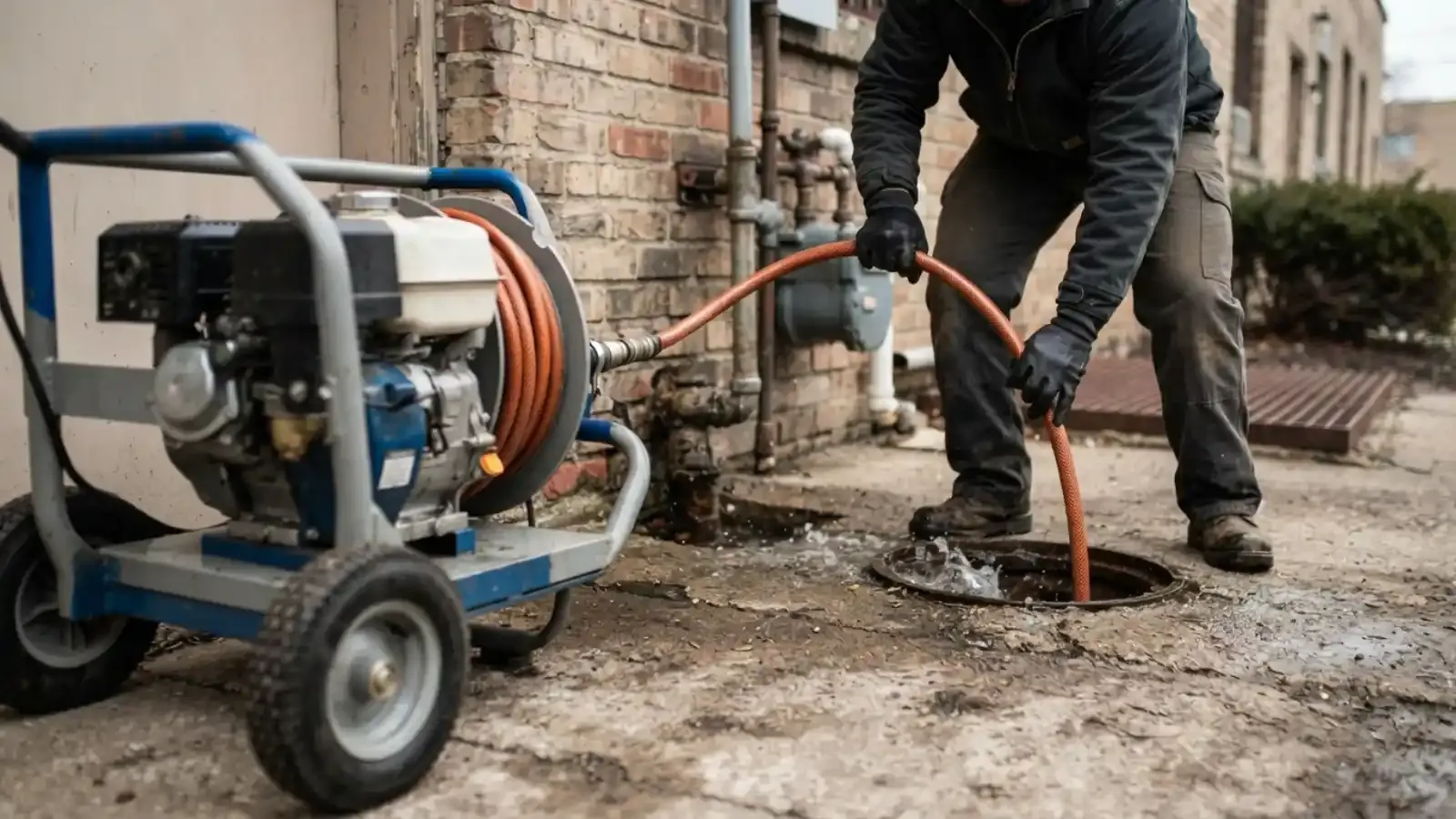
A jetting machine pumps water through a flexible hose at high pressure and high flow. The hose ends in a nozzle with several angled ports. Some ports shoot forward to break a blockage, and others shoot backward to pull the hose along the pipe and to blast the walls on the way out.
The water does the work, not a blade. That makes jetting good at getting rid of coatings, because it scours the entire circumference of the pipe. A cable cuts a hole the width of its head. A jet can restore much of the pipe's original bore if the pipe is sound.
Nozzle types and what each is meant for
The nozzle is chosen to match the blockage and the pipe. Here is how the common ones differ.
| Nozzle | Used for | Watch for |
|---|---|---|
| Forward-penetrating head | Opening a fully blocked line so the hose can travel | Does little for wall coatings on its own |
| Rear-facing flushing head | Pulling the hose along and rinsing debris downstream | Needs the debris to have somewhere to go |
| Rotating head | Scouring grease and scale from pipe walls | Pressure must match the pipe material |
| Root-cutting head | Clearing roots that have entered joints | Roots grow back if the joint stays open |
For a main line backing up into the house, see our notes on sewer line cleaning, which often starts with a cable before jetting.
Why we put a camera in first
Pressure is only useful in a pipe that can take it. Before we jet a line with a history of trouble, we prefer to look at it. A camera on a push rod shows the pipe material, the scale, the joints and any sag or break.
That look protects you in two ways. It stops us from putting a high-pressure hose into a pipe that is cracked or collapsed, which could make things worse. And it lets us show you the same line after jetting, so you can see the difference instead of taking our word for it.
Same drain clogging again and again?
Call the 24/7 line and tell us how often it has failed. We will tell you honestly whether jetting, a cable or a repair is the better path and give a clear price before work starts.
Call (973) 488-5410Pipes that should not be jetted
Jetting is aggressive on purpose. Some pipes cannot handle it. A section that has collapsed will not pass a hose, and forcing it risks a wider failure. Pipe that is cracked or has a pulled-apart joint can leak jetting water into the soil or lift further.
Fiber conduit sold decades ago as Orangeburg pipe, which is bonded paper and tar, softens and deforms and does not tolerate high pressure well. In those cases we choose a gentler method or recommend a repair. A good plumber does not use a tool because it is on the truck. We use the one that fits the pipe.
Jetting is routine maintenance, but a repair that follows it falls under the National Standard Plumbing Code, 2024 edition, which Kearny says plumbing plans must follow. Permitted work receives an inspection.
Grease, scale and roots: what jetting clears best
Grease is the best case for a jet. It builds on the pipe wall layer by layer and is exactly what cables leave behind. Water at pressure shears it off and carries it to the main. For commercial kitchens, grease also moves downstream, so jetting is often paired with a check of the grease trap.
Scale is the rough mineral and rust crust that cast iron develops over decades. Roots are a mixed case. Jetting cleans the strands out of the line, but it cannot seal the joint they came through, so roots can return unless the opening is repaired.
Good candidates for scheduled jetting
Jetting makes the most sense as maintenance, not just as a response to a crisis. These situations call for it.
- A kitchen line, in a restaurant or a large home, that clogs again within weeks of cabling.
- A multifamily building where many fixtures share one stack and one lateral.
- A cast iron line with rough interior scale that catches paper.
- A main line where the camera shows thick grease, soap or mineral buildup.
- A property with a pattern of backups that cabling has not solved.
If a line backs up only occasionally and the camera shows a clean, sound pipe, a simple cable is enough, and jetting would cost more than it earns.
Jetting older and low-lying lines in Kearny
Kearny's history goes back to the 1800s, and many older buildings sit on drain lines that have been in service for generations. Cast iron and clay are common in that age range, and both collect scale and offset joints over time. Homes built before about 1960 are the most likely to have them, though we confirm with a camera first.
Jetting pushes debris downstream, so we flush it all the way to the main rather than leaving it in the lateral. In parts of town that depend on pumping stations, the Kearny Municipal Utilities Authority and the town's DPW manage the public side, while the owner is responsible for the lateral. Across the river, Belleville buildings often face the same age-related buildup.
What affects the price of hydro jetting
We give a clear price before work starts. Jetting usually costs more than a basic cable visit because it uses heavier equipment and more time, so it helps to understand what drives the number.
In many cases jetting on a regular schedule costs less over a year than repeated emergency cabling. Want a clear price on your line? Call (973) 488-5410.
After the jet: what a clean line should do
When the job is done, water should flow freely and quietly with no gurgling at other fixtures. We run water through the line to confirm. If we ran a camera, you will see the cleaned pipe, and we will point out anything we noticed, such as a joint, a sag or a spot that holds water.
Jetting does not make a pipe new. A line with a belly will still hold water in the low spot. We tell you that and explain whether the pipe needs repair, such as sewer line repair, or whether routine cleaning will keep it working.
Frequently asked questions
Yes. The dispatch line is open 24 hours a day, seven days a week. A restaurant line that has stopped during service or a main line that is backing up is treated as an emergency at any hour. Planned jetting can be booked as a same-day appointment when the schedule allows.
For wall buildup like grease and scale, yes. A cable opens a hole through the middle, and a jet cleans the whole inside of the pipe. For a simple clog in a healthy line, a cable is faster and cheaper. We pick the tool to match the problem.
In sound pipe, no, because pressure and nozzle are set to the pipe. In a pipe that is cracked, collapsed or made of weak material, jetting can make things worse. That is why we often camera the line before we decide.
It usually costs more than a basic cable visit because it needs heavier equipment and more time. The line size, length, condition and amount of buildup all matter. We give a clear price before work starts. Call (973) 488-5410 to describe your line.
It clears roots out of the pipe, but it cannot close the joint they entered through. If the joint stays open, roots usually return. Jetting plus a repair at the entry point is the lasting fix, and a periodic cleaning is the budget option.
It depends on volume and grease control. Some kitchens need it every few months and others once a year. If your line clogs between cleanings, shorten the interval. A grease trap that is cleaned on time also stretches the schedule.
Often yes, when the pipe is sound and the pressure is matched to it. Cast iron with heavy scale benefits a lot. Thin or corroded pipe is a different story, and we check with a camera before using high pressure.
Unsure whether jetting or a cable is right? Call the 24/7 line and describe the problem. We will tell you straight.
Call (973) 488-5410