Sewer backup: what to do first
A sewer backup is a health hazard as well as a mess, because raw wastewater carries bacteria. We take these calls any hour of the night or weekend, and same-day appointments are available for non-urgent sewer problems such as a slow main or an odor.
- Stop using every water source. No flushing, no laundry, no dishwasher, no showers. Every gallon you send down goes to the lowest drain in the house.
- Keep children, pets and anyone with a weakened immune system out of the area. Wear rubber boots and gloves if you must enter, and do not touch the water with bare hands.
- Turn off the power to any basement area with standing water only if you can reach the panel without wading. Otherwise call the electric utility.
- Call Kearny DPW at (201) 998-3700. They check the town's main. If the main is flowing, the blockage or break is in your lateral. If it is blocked, the town clears it.
- Call (973) 488-5410 and tell us which fixtures are backing up and whether DPW found the main clear.
Do not pour chemical drain cleaner into a backed-up line. It will not fix a broken pipe and it makes the line more dangerous to open.
Clog or break: how to tell
A clog and a broken pipe look alike at first, because both send water back up. The difference shows in the pattern. A clog opens with a cable and stays open for months. A break, a collapse or a bad offset returns within days or weeks, because the cable clears the blockage but the damaged pipe catches new debris.
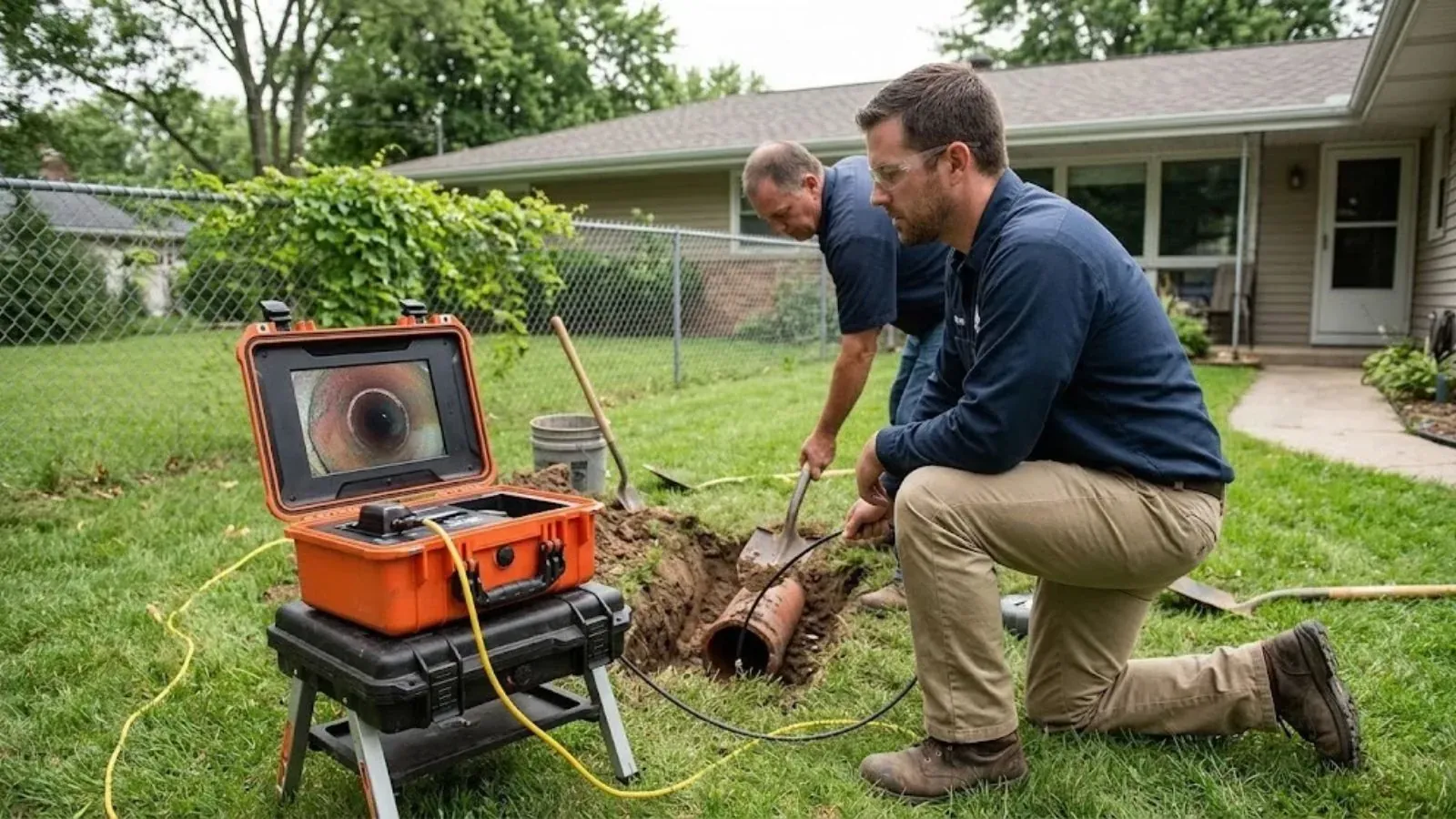
A camera settles it. We feed a small waterproof camera down the line from a cleanout, watch the video and mark the depth and the position of any defect. Then we show you what we saw, so the repair decision is based on the pipe itself.
Repair methods: dig, line or burst
Sewer repair has more options than most homeowners expect. The right choice depends on what the camera shows, how deep the line is and what sits above it.
| Method | How it works | Best when | Trade-off |
|---|---|---|---|
| Spot repair (dig) | Excavate to the defect, cut out the bad section and install new pipe | One short break or offset in an otherwise sound line | Digs up a small area, surface restoration is separate |
| Trenchless lining | A resin-soaked liner is pulled in and cured, forming a new pipe inside the old one | Cracks, root intrusion and joint leaks in a line that is still round | Cannot fix a collapse or a deep sag, and shrinks the inner diameter slightly |
| Pipe bursting | A cone pulls new pipe through the old line, breaking the old pipe outward | Long runs under driveways, patios or landscaping | Needs entry and exit pits and a clear path |
| Full replacement (trench) | Remove the old line and lay new pipe at the right slope | Collapsed, bellied or heavily offset pipe | Most disruptive and usually the most costly |
A liner follows the shape of the old pipe. If the line has a belly that holds water, lining preserves it. A camera and a slope check tell us which method fits.
If you are only at the information stage, a sewer camera inspection gives you the picture without committing to a repair.
Why sewer lines fail
Roots are the best-known cause. Tree roots grow toward the moisture and nutrients in a sewer line and enter through any joint or hairline crack. Once inside, they thicken and catch debris. Clay pipe has many short sections with many joints, which makes it a favorite for roots.
Other causes include cast iron that rusts and flakes from the inside, bituminous fiber pipe (often called Orangeburg) that softens and deforms, ground that settles and offsets the joints, and heavy loads above shallow pipe. Homes built before about 1960 may have any of these, though the camera is the only way to know what yours has.
Sewage backing up right now?
Stop running water, call Kearny DPW for the main, then call our 24/7 line. We will give you a clear price before work starts.
Call (973) 488-5410Who owns the sewer lateral in Kearny
Kearny's DPW is clear on this. If sewage backs up into a house, they check the town's main. If the main is flowing, the blockage is in the lateral, and the property owner is responsible for maintaining and repairing the lateral sewer line.
In some low-lying parts of town, waste will not flow by gravity and sanitary pumping stations lift it instead. In the Meadowlands district and the South Kearny industrial areas, the Kearny Municipal Utilities Authority handles wastewater collection, with its own 24/7 emergency staff, at 973-465-5367. A property there may need KMUA instead of DPW.
Next door, Lyndhurst's township code requires owners doing new construction or major renovation to replace the sewer lateral and connect to the street main. See our Lyndhurst plumbing page for that area.
Sewer repairs follow the National Standard Plumbing Code, 2024 edition, which Kearny's code office says plumbing plans must follow, and permit rules vary, so ask the office before digging starts. Every permit receives an inspection before the trench is closed.
What affects the price of sewer line repair
We give a clear price before work starts. Sewer work varies more than almost any other plumbing job, so we explain what drives it.
Restoring pavement, landscaping and finished floors is separate from the pipe work. Want your real number? Call (973) 488-5410 and tell us what the camera or DPW found.
Warning signs before a full backup
Sewer lines rarely fail without warning. If you notice any of these, a camera check now is cheaper than an emergency later.
- Gurgling toilets or drains when another fixture is used, a sign the line is restricted.
- Slow drains in more than one fixture, especially on the lowest floor.
- Sewer smell in the basement or yard with no visible cause.
- A sunken or unusually green patch of lawn along the path of the line.
- Repeated clogs that return after cabling, which suggests a damaged pipe instead of a one-time blockage.
For roots or grease that need to come out before a camera can see, sewer line cleaning is usually the first step.
Permits, inspection and keeping it honest
Under the NJ Uniform Construction Code, plumbing work on an existing building needs a construction permit. The only listed exemption is ordinary maintenance, which includes routine repair. A new or relined sewer lateral is generally more than routine repair, so ask the Kearny construction code office. Kearny's page says all permits require an inspection.
We do not recommend digging a line that a liner can fix, and we do not recommend lining a line that has collapsed. If a spot repair or regular cleaning on a schedule will carry you for years, we say so. The camera video is yours to keep for the repair decision and the permit file.
While you wait: protecting the house
If wastewater reached the floor, keep the room ventilated and keep children away. Nights and weekends are the most common time for backups, because that is when the house uses the most water. Move belongings off the floor and avoid carrying sewage-wet items through clean areas.
Do not run the washing machine to see if the line has cleared. If you have a sump pump or ejector pit, check that it is not discharging into the sanitary line, because that is prohibited in many towns. Our drain cleaning page covers the clog side of backups.
Frequently asked questions
It varies widely with the method, depth, length, what sits over the pipe and permit costs. A short spot repair is the lowest tier, relining a long run is higher, and a full trench replacement is typically the highest. We give a clear price before work starts. Call (973) 488-5410 for a real number.
Yes. The dispatch line is open around the clock. A backup into the home is treated as an emergency at any hour. Stop using water and call DPW at (201) 998-3700 to check the main. Same-day appointments cover non-urgent sewer problems when the schedule allows.
In Kearny, yes. DPW checks the town's main. If the main is flowing, the lateral is the owner's to maintain and repair. If the main is blocked, the town clears it. Properties in the Meadowlands and South Kearny may be served by KMUA instead.
It repairs the pipe without digging the full length. Methods include lining the old pipe with a cured resin sleeve and pipe bursting. It suits lines that still hold their shape. A collapsed or heavily bellied pipe usually needs excavation.
Often yes. A cutting head or hydro jet clears roots, and a liner can seal the joints so roots do not re-enter. If roots have broken the pipe apart, cutting does not help and the damaged section needs repair.
NJ's Uniform Construction Code requires a construction permit for plumbing work on existing buildings. The only listed exemption is ordinary maintenance, including routine repair. A new or relined lateral may be more than that, so ask the Kearny construction code office. All permits require an inspection.
A spot repair is often finished in a day. Lining and bursting usually take a day or two, plus curing time for a liner. A long trench replacement takes longer. Weather, utility markouts and the inspection also affect the schedule.
Not sure if it is a clog or a broken pipe? Call the 24/7 line and a dispatcher will help you work out the next step.
Call (973) 488-5410