
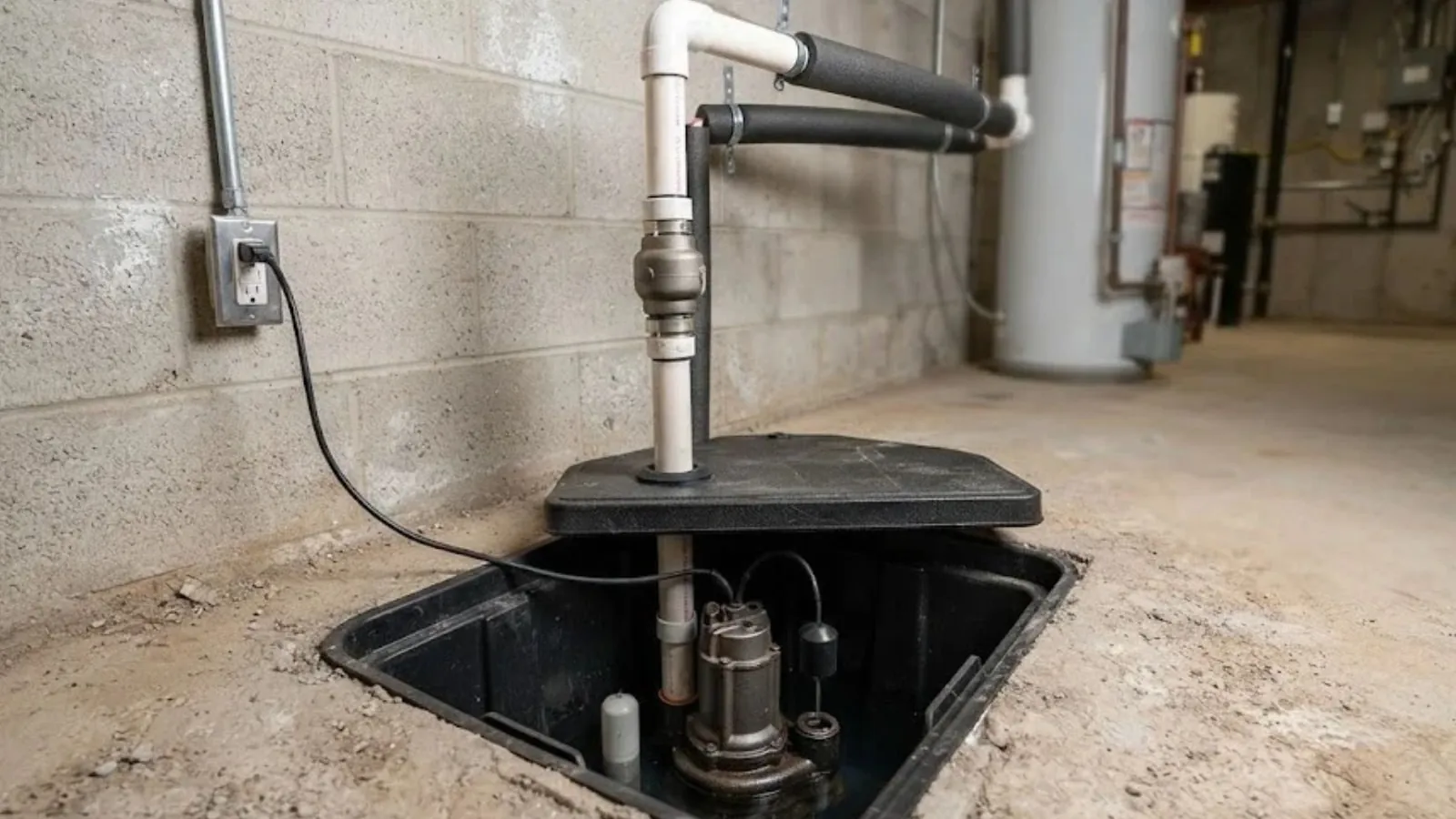
What the discharge pipe does
A sump pump pushes water up through a vertical pipe, past a check valve, then through the basement wall or rim joist and outdoors. The pipe is usually PVC, one and a half or two inches across. It must slope away from the house and end far enough from the foundation that the water does not soak back to the same pit.
Because the pump pushes against gravity, any weakness shows up fast. A crack leaks spray into the basement, a blockage makes the motor run hot, and a pipe that drains back into the pit causes constant cycling.
Signs the discharge line is the problem
Pump trouble gets blamed on the motor, yet the pipe is often the real cause. Look for these signs before replacing anything.
- The pump runs but the water level in the pit barely drops, which can mean the check valve is stuck or the line is blocked.
- Water sprays or drips near a fitting inside the basement during a pump cycle.
- A loud hammering knock each time the pump stops, from a failed or missing check valve.
- Ice at the outdoor end in winter, or a pipe that carries no flow in a cold snap.
- A wet patch or eroded soil beside the foundation where the line exits, pointing to a separated joint or a pipe that ends too close.
If the pump itself is old, noisy or running constantly, see sump pump installation and repair to sort out whether the pit equipment or the pipe needs attention.
Common failures and how they are fixed
Most problems fall into a few categories, each with its own repair.
| Problem | Cause | Typical repair |
|---|---|---|
| Cracked or split pipe | Freeze damage, age or an impact | Cut out the bad section and replace it with new PVC and couplings |
| Separated joint | Dry-fit or poorly glued connection that vibrates loose | Clean, prime and re-cement the joint, adding a union for future service |
| Blocked outlet | Dirt, leaves, a nest or ice at the end of the line | Clear the line, add a screened grate or a bubbler-style end |
| Failed check valve | Wear, debris or a weak spring | Replace the valve and confirm the arrow points up |
| Flat or backwards slope | Settling, or a poor first install | Re-hang the run with proper pitch away from the house |
A discharge line that must be changed in several places is usually cheaper to redo in one pass than to patch piece by piece.
Pump running but basement still wet?
Call the 24/7 dispatch line and describe where water is leaking. We will tell you what to check first.
Call (973) 488-5410How the repair is actually done
A repair starts by turning off power to the pump, ideally at the breaker, and pulling the plug if the outlet is within reach. The old section is cut with a hacksaw or a PVC cutter at a square angle, and the cut ends are deburred. New pipe is dry fit first, marked, then primed and cemented with PVC solvent cement.
Allow the cement to cure for the time on the can before running the pump. Many repairs add a union near the pump or a removable coupling so the pump can be pulled in the future without cutting anything. The pump is then tested by pouring water into the pit and watching every fitting through a full cycle.
Where the water may not go
The discharge outlet is not a free choice. In Lyndhurst, the township code says stormwater and unpolluted drainage may not go into the sanitary sewer. That means a sump pump line cannot be tied into the house's sewer drain, and the water has to be directed to a lawn, a yard drain or another approved outlet.
Kearny may have its own rule. Ask the Kearny construction code office before you connect or reroute a discharge line, because permit rules vary and a drain tied to the wrong system can cause a violation and sewage overload during storms.
Freezing, clogging and the winter problem
A line that exits near the ground can freeze solid in a hard cold spell, which pushes pressure back onto the pump and the check valve. Keep the line short outside, pitch it so it drains empty after each cycle, and avoid low spots where water can sit and freeze.
Some homeowners add a second relief opening, a small hole or a dedicated pop-up, so water can still escape if the main outlet ices over. Burying the line below frost depth protects it better, though that is a bigger repair and depends on soil and obstructions.
Neighboring code on sump discharge
The Lyndhurst township code says that stormwater and unpolluted drainage may not go into the sanitary sewer. That is a Lyndhurst fact, and it is the clearest local rule we can point to for sump discharge.
In Kearny, the town DPW says the property owner maintains the lateral sewer line that connects a house to the main. Because the lateral is private and carries sanitary flow, anything that adds clear water to it works against the town's system. For which outlets Kearny allows, ask the construction code office. Some low-lying areas of town depend on pumping stations, which is another reason extra water matters.
Source: Lyndhurst township code (chapter 12) and Kearny DPW sewer backup guidance
What affects discharge pipe repair cost
Pricing depends on the conditions, and we give a clear price before work starts.
Want a real figure for your house? Call (973) 488-5410, describe where the water leaks or backs up, and we will tell you what the visit involves.
Pitfalls to avoid
Do not use flexible corrugated hose as a permanent discharge line, since it traps water and collapses over time. Do not use PVC cement on a threaded joint, since it will not seal there. If you add a small relief hole, put it below the check valve and expect a little spray during each cycle.
For tight rowhouse lots, discharge room can be limited. Narrow lots, such as those in Harrison, make this harder, and Lyndhurst owners should read the township code mentioned above.
Frequently asked questions
The pump will run but the water level in the pit drops slowly or not at all, and the motor may feel hot. Check the outdoor end for ice, leaves or a nest. If the end is clear, the check valve or a crushed section inside the line may be to blame.
A short section is within reach if you can cut square, dry fit and use PVC primer and cement. Shut off power first, and let the cement cure before running the pump. A long run, a masonry exit or a doubtful outlet location is better left to a plumber.
We cannot state Kearny's rule. Lyndhurst's code bars stormwater from the sanitary sewer, which is a common standard. For Kearny, ask the construction code office before connecting, rerouting or extending a discharge line, because permit rules vary.
Water left sitting in a low or flat section can freeze solid in a cold spell. Pitching the line so it drains empty, shortening the outdoor run and adding a relief opening reduce the risk. Burying the line below frost depth is the strongest fix.
It depends on how long the damaged run is, how easy it is to reach, how the pipe exits the foundation and where the new outlet will sit. We give a clear price before work starts, and (973) 488-5410 reaches us to describe your case.
Yes, in most installations. It keeps water in the pipe from running back into the pit when the pump stops, which reduces short cycling and wear. A failed check valve is a common cause of knocking, and replacing it is a short job.
It can be, depending on grading and local rules. A line that ends too close to the property edge sends water where it is not wanted. Ask the construction code office what applies in your area, and consider extending the pipe or changing the outlet.
Not sure which part of the line has failed? Call the 24/7 line and a dispatcher will walk through it with you.
Call (973) 488-5410