
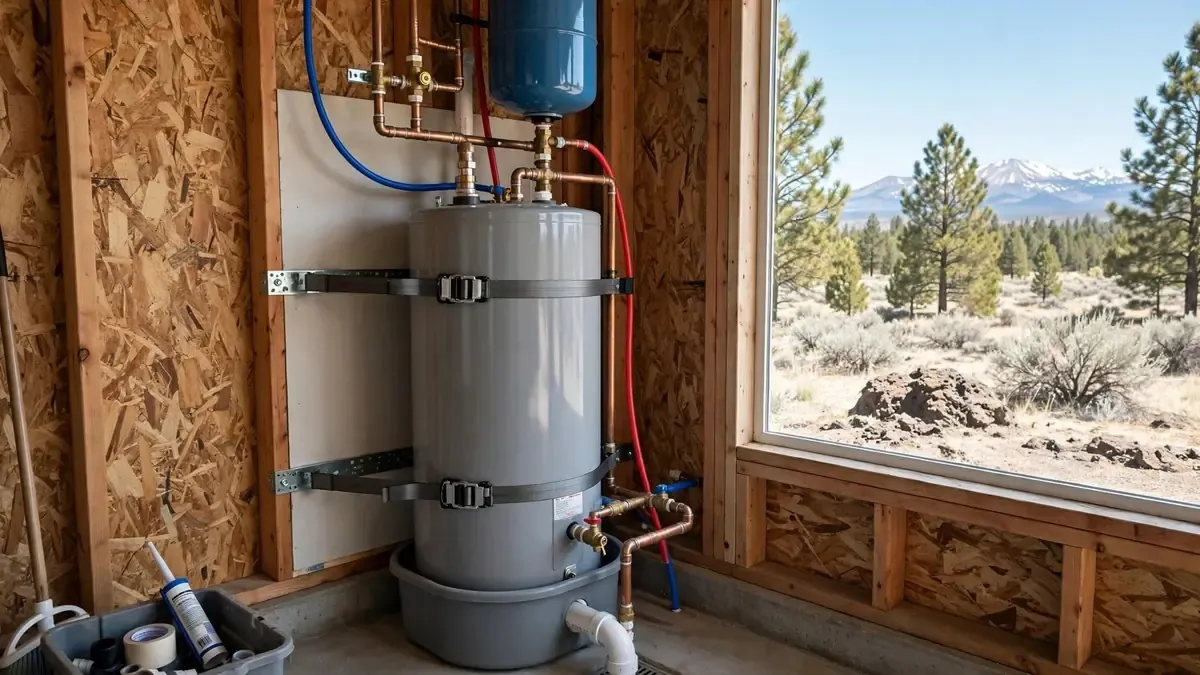
When a failing water heater is an emergency
A tank that leaks from its body does not get better. The steel liner has corroded through, and the flow only grows. A leak is an emergency, and so is a heater that smells of gas. Do these things in this order.
- If you smell gas, leave the building at once and call your gas utility or 911 before you call us. Do not flip switches or light anything.
- For an electric heater, turn off its breaker at the panel. For a gas heater, turn the gas control knob to off or pilot, if no gas smell is present.
- Close the cold water shutoff valve on the pipe feeding the top of the tank. A lever turned across the pipe, or a wheel turned clockwise, stops the supply.
- Open one hot tap upstairs so the tank can vent as it drains, and do not touch water that has been heated, because it can scald.
- Call (973) 488-5410. Tell us gas or electric, how big the tank looks and where it sits, so we can bring the right unit.
If the leak is at a pipe fitting on top instead of from the tank body, the heater may be repairable. We check that first on every call.
Signs the tank has failed for good
Water at the base is the clearest sign, but check where it comes from. A drip at the relief valve or a top fitting is often a separate repair. Water seeping from the jacket or pooling beneath the tank with no pipe above it means the steel shell has rusted through.
Other signs show up earlier. Rust-colored hot water, a rumbling or popping sound as sediment cooks at the bottom, and hot water that runs out far sooner than it used to all point to a tank near the end of its life. Many tanks last roughly 8 to 12 years, and age is a good reason to replace instead of repair.
Repair or replace: a plain decision table
Replacing is not always the answer. Use this to see where your heater falls, and call to talk it through.
| Situation | Usually | Why |
|---|---|---|
| Leak from the tank body | Replace | A corroded shell cannot be patched |
| Tank under about 6 years old, no hot water, no leak | Repair | A thermostat, element or gas valve is cheaper than a new tank |
| Tank past 10 years, with rust in the water | Replace | A repair buys little time on a failing tank |
| Leak only at the relief valve or a top fitting | Repair | A valve or connection is a fraction of a tank |
| Frequent repairs in one year | Replace | Repeated parts costs add up to a new unit |
For the repair path, see water heater repair. If you want to compare a tank to a tankless unit, our tankless water heater page covers the trade-offs.
Choosing the replacement: size, fuel and fit
The best replacement is usually the same fuel and a similar size, because that keeps the gas line, vent or electrical circuit unchanged. Switching fuel is possible but adds work, such as a new circuit, a new vent or a gas line.
Size is about people and habits, not just gallons. A household with several people showering in the morning needs a bigger first-hour supply than a couple. Tell us how many people live in the house and when hot water is used most, and we will match a tank to that instead of copying the old label.
Tank leaking or hot water gone?
Call the 24/7 line, shut off the cold supply and power, and tell us the fuel and size. We will give you a clear price before work starts.
Call (973) 488-5410What we check before the new tank goes in
Replacing the tank is the easy part. The surrounding items are what make an install safe and legal.
- The condition of the shutoff valve, because a seized valve can fail when we close it.
- The flexible water connectors and the gas connector, which are replaced with new ones.
- The temperature and pressure relief valve and its discharge pipe, which must run down toward the floor.
- The vent on a gas unit, including slope, draft and signs of backdrafting or corrosion.
- Whether the house needs an expansion tank, a drain pan or a new sediment trap on the gas line.
We show you anything that fails this list and explain why before we add it to the work.
What a replacement visit involves
After shutting off power or gas and water, we drain the old tank to a floor drain or sump with a hose. We disconnect the water lines, the gas or electric supply and the vent, and we remove the old unit. A tank full of water is heavy, so draining first matters.
The new unit is set in place, level, on a pan where one is needed. We connect the water with new flexible lines, add the relief valve and discharge pipe, connect the gas or power, and check for leaks. Then we fill the tank, purge the air and test the heating before we leave.
Permit and inspection for a new water heater in Kearny
Kearny's construction code office states that a new or replacement hot water heater needs a zoning permit and a construction permit with the plumbing subcode. All permits require an inspection. Plumbing work in the state must follow the National Standard Plumbing Code, and a licensed plumber must do the work.
The town says small jobs typically take about 7 business days to process, with up to 20 working days allowed. Because processing time varies, ask the construction code office at (201) 955-7880 how it handles an urgent replacement. We pull the permit and arrange the inspection so it does not fall on you.
According to Kearny's permit page, plumbing plans must follow the National Standard Plumbing Code, 2024 edition, and every permit requires an inspection before the job is closed out.
What affects the price of water heater replacement
We give a clear price before work starts. The tank itself is only part of the number.
A new tank also comes with a manufacturer's warranty, and the terms differ by model, so ask us for the details. For a clear price on your unit, call (973) 488-5410.
Hot water while you wait and water that damages the tank
Until the new tank is in, you can heat water on the stove for washing. Do not run the failed unit. A leaking electric element dry-fired is a hazard, and a gas unit with a damaged vent is a risk.
Water chemistry affects how long a tank lasts. Hard water builds sediment and shortens life. Kearny buys its water from the North Jersey District Water Supply Commission, and the town's 2024 report lists no hardness figure, so ask the water utility if you want your own number. In neighboring Harrison, the Passaic Valley Water Commission reported about 84 to 100 ppm, which falls in the moderately hard range.
Older basements, tight closets and replacement in Kearny homes
Many Kearny houses date to the late 1800s and early 1900s, and the tank is often in a low basement corner near a floor drain, or in a cramped utility closet. Those spots matter. A basement heater that sits on the floor of a room prone to flooding does better raised on a stand.
In older homes, the supply piping to the tank may be galvanized, and it can crumble when disturbed. We tell you before we start if the connections look fragile, and we can replace the short section with copper or PEX. Before you add a new line, our water heater installation page explains the planned process in more detail.
Frequently asked questions
Yes. Our dispatch line is open 24 hours a day, seven days a week, and a leaking tank is treated as an emergency at any hour. Same-day replacement is often possible when we have the right unit available. Call (973) 488-5410 and tell us the fuel and tank size.
Sometimes. A leak from the relief valve, a drain valve or a top fitting can be fixed. A leak from the tank body means the steel has corroded through, and no patch will hold. We check the source of the water before recommending replacement.
A like-for-like swap is often done in a half day, plus time to heat the new tank. A fuel change, vent work or a hard-to-reach location takes longer. We give you a time estimate once we see the setup.
It depends on the tank type and size, whether the fuel changes, what code upgrades are needed and how hard the unit is to reach. We give a clear price before work starts, so you decide with the full number in hand.
Yes. Kearny's construction code office says a new or replacement water heater needs a zoning permit and a construction permit with the plumbing subcode, and all permits require inspection. We handle the paperwork and the inspection for you.
Look at the rating plate on the side. The serial number usually encodes the month and year of manufacture, but each brand uses its own format. If you cannot read it, we can decode it when we visit.
Only if it suits your home. Tankless units save space and give endless hot water, but they cost more up front and may need a bigger gas line or a new vent. A tank is simpler for an emergency swap. You can always plan a switch later.
Have a leaking tank or no hot water? Call the 24/7 line and a dispatcher will help you shut it down safely.
Call (973) 488-5410