
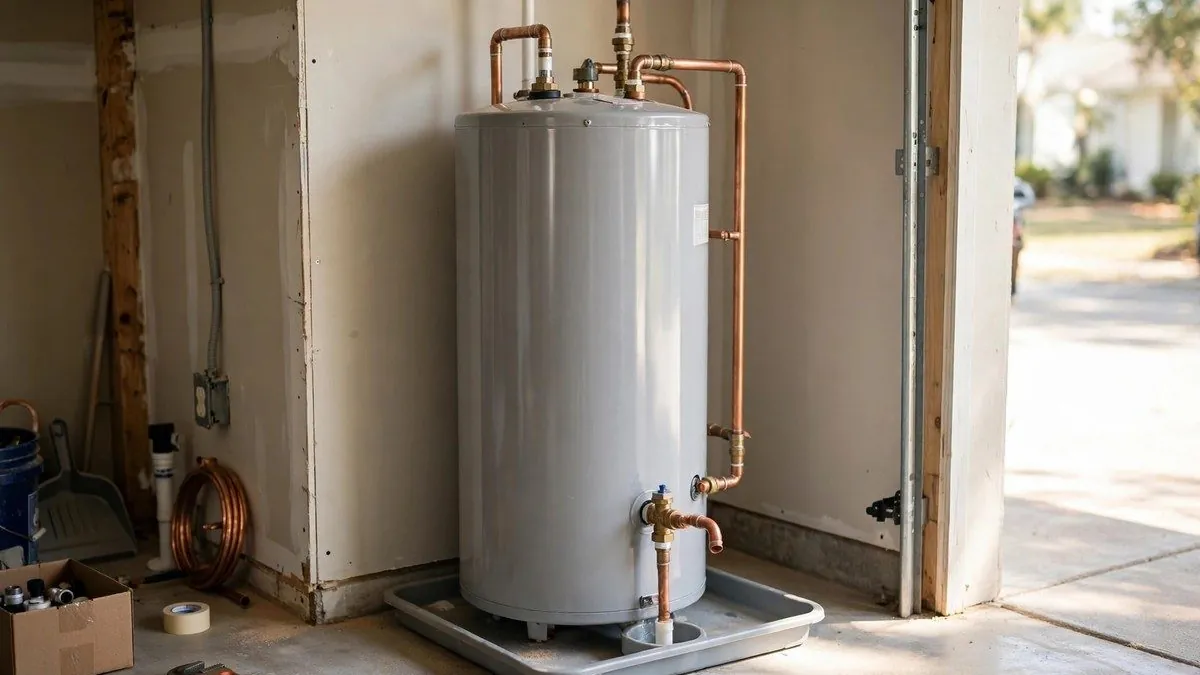
What a tank installation includes
The tank is only part of the job. A complete installation drains and removes the old unit, sets the new one on a level base, connects cold and hot water with new flex lines or copper, and fits a temperature and pressure relief valve with a proper discharge pipe.
A gas unit also needs a gas connection with a shutoff and drip leg, plus a flue that draws combustion gases outside. An electric unit needs a correctly sized circuit. Then the tank is filled, purged of air, tested for leaks and set to a safe temperature.
Choosing the right size
Tank size is a balance between how much hot water you use at once and how much space you have. A common range for homes is 30 to 80 gallons. A bigger tank holds more but also loses more heat while it sits.
The first hour rating on the yellow energy label matters more than gallons alone. It tells you how much hot water the heater can deliver in an hour starting full. Count your biggest morning stretch, such as two showers and a dishwasher, and match that to the rating rather than guessing from tank size.
Gas, electric or something else
Your existing fuel is usually the right starting point because changing it adds work. This table shows the trade-offs.
| Type | What it needs | Trade-off |
|---|---|---|
| Atmospheric gas | Gas line, a chimney or vent pipe with proper draft, combustion air | Lowest equipment cost, but draft problems can cause backdrafting |
| Power vent gas | Gas line, electric outlet, plastic vent through wall or roof | More flexible venting, uses power, has a fan that can fail |
| Electric resistance | Dedicated circuit and breaker sized for the unit | No venting at all, usually slower recovery and higher running cost |
| Heat pump tank | Electric circuit, open space and condensate drain | Efficient, but needs clearance, cools the room and costs more up front |
Switching fuel changes the permit scope and may need electrical or gas line work. For a different approach, see tankless water heater installation.
If your basement or closet is tight, venting and clearance often decide the choice before efficiency does.
Planning a tank water heater installation?
Call the 24/7 line and tell us the fuel, size and location of your current heater. We will give a clear price before work starts and handle the permit steps.
Call (973) 488-5410What to prepare before the installer arrives
A little preparation saves time and keeps the job moving.
- Clear a path to the old unit and a work area of about three feet around it.
- Know where the main water shutoff is and check that it turns. A stuck shutoff valve can stop the job.
- Move stored items, laundry and anything that could be damaged by water or dust.
- Find the floor drain, if any, and the nearest place a discharge hose can run.
- Note the make, model and label data on the old heater, and a photo helps.
- Expect the hot water to be off for several hours, so plan showers and laundry around it.
If the old unit is already leaking, tell us on the phone so the crew brings the right gear for water cleanup.
Venting and combustion air
Venting is the hidden half of a gas installation. An atmospheric heater relies on hot flue gas rising through a pipe or chimney. If the pipe is too long, too flat or blocked, exhaust can spill back into the house. Combustion air must also reach the burner.
That is why a good installer checks the vent for rust, slope and connections before it is reused. Power vent units push gas out with a fan and use plastic pipe. Either type should be tested with a draft check and a carbon monoxide detector nearby.
Valves, expansion tanks and the details that last
The temperature and pressure relief valve is a safety device. Its discharge pipe must run downward to a safe spot and must never be capped or reduced. A shutoff valve on the cold inlet makes future service easier.
If your home has a backflow preventer or a pressure reducing valve, thermal expansion has nowhere to go and pressure spikes each time the heater runs. An expansion tank absorbs that swing. Dielectric fittings or nipples reduce corrosion between steel and copper. A drain pan helps when the heater sits over finished space.
Permits and inspection for water heaters in Kearny
Kearny's Construction Code Enforcement says that a new or replacement hot water heater needs a zoning permit and a construction permit with the plumbing subcode. All permits require an inspection. Plumbing plans must follow the National Standard Plumbing Code, 2024 edition.
Typical processing is about 7 business days for small jobs and 5 to 7 business days for complex ones, and up to 20 working days is allowed. The permit fee for plumbing is set by ordinance. The front office is at (201) 955-7880, Monday to Friday, 8 am to 4 pm.
State rules point the same way. A construction permit is required for plumbing work on existing buildings, and the only listed exemption is ordinary maintenance. For questions not covered here, ask the Kearny construction code office.
Source: Kearny Construction Code Enforcement page and NJ Uniform Construction Code summary from the state DCA
Neighbors across the line may have different steps
Homeowners in North Arlington and Belleville sometimes ask whether the same process applies. Each town runs its own code office, so call theirs before you plan around a date.
Water source can matter too. Hardness and sediment vary by supplier, and harder water tends to build scale on the tank bottom over time. Ask your water utility for its hardness report if you want to know how fast that might happen.
How to check the finished work
When the installer is done, walk through these points together.
- The tank sits level on a stable base or in a drain pan, with clearance on the sides.
- The relief valve has a full size discharge pipe that ends near the floor, with no cap or threads.
- Gas lines have a shutoff and a leak test, and the flue slopes up and is sealed at each joint.
- Water connections are dry after the first heat cycle. Check them again the next day.
- The thermostat is set to a safe temperature, often around 120 degrees F for households with children.
- You know where the gas, electric and water shutoffs are, and you have the manual and warranty paperwork.
Keep the permit and inspection record with the manual. It helps if you ever sell the house or file a claim.
What changes the price of a tank installation
We give a clear price before work starts. These factors move it the most.
Warranty length also differs by model, so ask what the tank and the labor each cover. Ready to plan an installation? Call (973) 488-5410 and we will walk through your setup.
Frequently asked questions
A straightforward swap usually takes a few hours, from draining the old tank to the first heat cycle. Vent changes, a fuel switch or code updates add time. The permit and inspection happen on the town's schedule, which may be separate from the install visit.
Yes. Kearny's code office says a new or replacement hot water heater needs a zoning permit and a construction permit with the plumbing subcode, and all permits require an inspection. Call the Kearny construction code office at (201) 955-7880 for current steps.
Match the first hour rating to your busiest hour of hot water use, not just the gallons. A household with several people showering in the morning needs a higher rating than a couple living alone. Our crew can help estimate it.
In New Jersey, plumbing work may only be performed by a licensed master plumber or an authorized plumbing contractor, with limited exceptions. Gas, venting and permit rules are the reasons. A poor install can cause leaks, scalding or carbon monoxide.
Often yes, if your plumbing has a check valve or pressure reducing valve that keeps heated water from pushing back into the main. Without space to expand, pressure spikes and strains fittings. A pressure gauge on a hose bib will tell you.
A bad thermostat, element or gas valve can be a modest repair on a sound tank. A leaking tank body cannot be patched. A tank unit often lasts roughly 8 to 12 years, so weigh the repair against the life left. Our crew will say which applies.
Have a question we did not answer? Call the 24/7 line and ask a dispatcher.
Call (973) 488-5410